
How to Search Los Angeles County Criminal Records
The main path for a Los Angeles County criminal records search starts at the PAOS criminal defendant name search. The page lets the public look up a criminal case number by defendant name. Results return the case number, defendant name, filing date, and filing location. Once a case number is known, the PAOS document image service can be used to buy and download scanned filings. Traffic and other infractions are not part of the criminal search and route to the traffic division instead.
A typical PAOS criminal lookup runs as a guest transaction or under a registered account. Guest users pay per search. The court cites California Rule of Court 2.503 and Government Code section 68150 as the legal basis for electronic records and fees. Results stay on screen for about two hours after a transaction. Purchased document images stay available for thirty days. Most searchers print or save the file as a PDF right after they buy it.
The steps below outline the public path from a name to a court file.
- Open the LA Superior Court PAOS criminal defendant name page and read the guest information notice on access fees.
- Enter the defendant name and run the name search. Results return case number, filing date, and filing location.
- Confirm the date range. Felony coverage starts in 1980. Misdemeanor coverage starts in 1988. Some older municipal-court misdemeanor data may reach back to 1983.
- For full case detail, take the case number to the Criminal Case Summary Online Service or contact the filing courthouse listed in the result.
- To pull scanned documents, switch to the PAOS document image service and enter the exact case number.
- For booking, bail, court dates, and current holds, run the same name through the LASD Inmate Information Center.
- If the case predates online coverage or is missing, contact Archives or the courthouse listed in any older paper docket.
Self-represented users with a record-clearing question can also use the LA Court Self-Help Service Catalog for county-specific guidance before they file forms.
Los Angeles County Criminal Records Search Fields
The PAOS criminal page does not expose the full first-name and last-name input split on its static information page. What the public side does confirm is a name input, a payment step, and the result fields returned after a match. The table below mirrors that public-facing material.
| Field Label | Type | Required | Notes |
|---|---|---|---|
| Defendant name | Text | Yes | Static page does not expose the exact split between first, last, and middle. |
| Guest or registered user | Transaction choice | Yes | Each criminal name search carries a fee. |
| Case Type | Result field | n/a | Felony or misdemeanor. |
| Case Number | Result field | n/a | Returned in the result list. |
| Defendant Name | Result field | n/a | Returned in the result list. |
| Filing Date | Result field | n/a | Returned in the result list. |
| Filing Location | Result field | n/a | Maps to one of the criminal courthouses. |
The same name often appears at more than one courthouse if the person had cases over many years. The filing location tells the user which clerk to call for paper copies.
The static field list maps to the Government Code section 68150 image shown later in this page, which is the cost-recovery rule the court cites on its fee notices.
Citing this rule on the page is useful because it explains why a Los Angeles County criminal records lookup carries a charge while many other state agency records do not. The same logic appears in section 68150 directly.
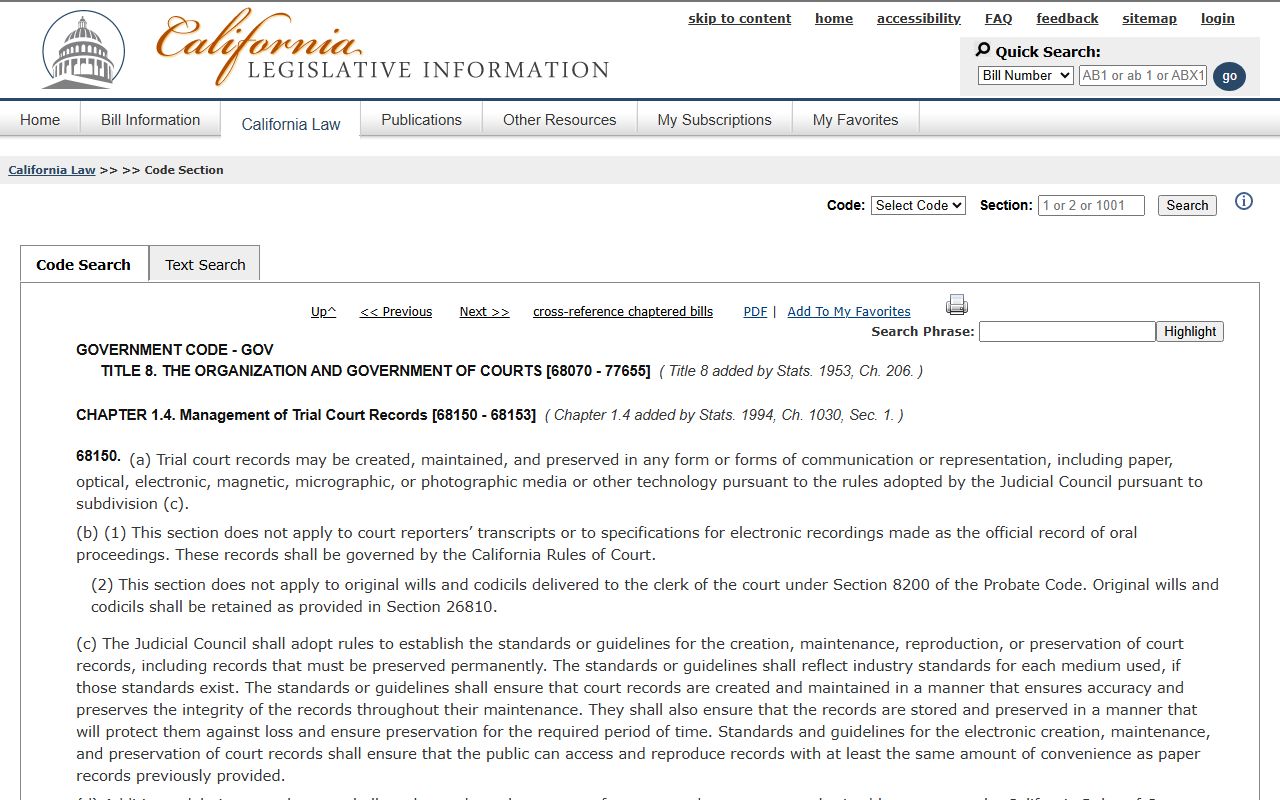
The statute is the basis the court uses to charge for name searches and to keep electronic case records under formal retention rules.
Felony vs Misdemeanor Coverage on PAOS
Coverage years are not the same for every kind of case. Felony cases on PAOS go back to 1980. Misdemeanor cases go back to 1988 as a baseline, with some older municipal-court misdemeanor records that may reach 1983 depending on when each former location automated its data. A user who runs a name and gets no result for a 1970s charge is not seeing a clean record. The case may exist on paper at Archives. The same is true for old infractions, which are kept out of the criminal name search by design and require a separate traffic search.
The court's coverage notes also include caveats that matter. Sealed cases and confidential cases are not part of public results. Documents filed in the courtroom are not always imaged. Some old felony files were transferred to off-site storage years ago and are no longer searchable by name in the online system. A reader running a Los Angeles County criminal records check on a person born before 1960 should expect gaps.
Federal cases are a separate system. Federal criminal matters that occurred in Los Angeles County are handled by the U.S. District Court for the Central District of California, not the Superior Court. Those files live on PACER.
Note: PAOS criminal search excludes traffic and infraction matters and routes those users to the Traffic Division for citation-based lookups.
What Criminal Court Records Show
A full criminal court file in Los Angeles County contains far more than the result line shown in a PAOS name list. The file usually opens with a complaint or an information. From there, the docket runs through arraignment, plea, motions, hearings, trial events if any, and the final disposition. The file can also include bail and bond orders, warrant entries, probation reports where public, sentencing minutes, abstracts of judgment, protective orders, and restitution orders.
Common visible fields across the criminal docket and minutes include the case number, case type, filing date, filing location, defendant name, party data, courtroom or department number, judicial officer, docket events, financial data, hearing details, and current case status. Sealed filings, juvenile data, and victim addresses are redacted or excluded by law. Social Security numbers and financial account numbers are filtered out of imaged documents under court rules.
The legal terms used in a Los Angeles County criminal file follow the standard California glossary.
- Arraignment
- The hearing where charges are read and a plea is entered.
- Plea
- The defendant's response, such as guilty, not guilty, or no contest.
- Disposition
- The current or final outcome of a charge or case.
- Conviction
- A finding or plea that establishes guilt.
- Sentence
- The punishment ordered after a conviction.
- Probation
- Supervised release under court-set conditions.
These terms appear in nearly every minute order and final judgment.
Arrest Records vs Court Cases vs Convictions
Three record types often get blended in casual conversation. They are not the same. An arrest record is a sheriff or police record made at booking. A criminal court case begins when a prosecutor files a complaint or an information. A conviction is the legal result of a plea or a verdict. A person can have an arrest with no court case. A person can have a court case that ends in dismissal. A person can have a charge that is reduced before any conviction.
| Arrest Record | Criminal Court Case | Conviction | |
|---|---|---|---|
| Source | LASD or local police | LA Superior Court | LA Superior Court |
| Created When | Booking | Charges filed | Plea or verdict |
| Burden of Proof | Probable cause | Filing standard | Beyond reasonable doubt |
| Where to Look | LASD Inmate Information Center | PAOS criminal name search | PAOS docket and final judgment |
| Public | Booking data per LASD policy | Yes, with redactions | Yes, with redactions |
The comparison block matters for background screening. Many private databases conflate an arrest with a conviction. California law and the federal Fair Credit Reporting Act treat them as distinct. A clean Los Angeles County criminal records check should track each charge from arrest through disposition before any conclusion is drawn.
Mugshots and LASD Booking Information
Booking photos and arrest data sit with the Los Angeles County Sheriff's Department. Sheriff Robert G. Luna leads the department, which is the largest sheriff's office in the United States. The public-facing booking data is reached through the LASD Inmate Information Center. The portal warns that a booking is not visible until about two hours after intake. It also uses a reCAPTCHA step to block scrapers. The general custody help line is (213) 473-6100.
The LASD Custody Division Manual section 3-04/040.00 lists the inmate fields the public can request: booking details, arrest information, bail amount, housing location, court dates and location, release date, holds, and visiting days and hours. The Records and ID Bureau notes that some investigative reports are kept back under Government Code section 7923.600, which covers law-enforcement investigatory records.
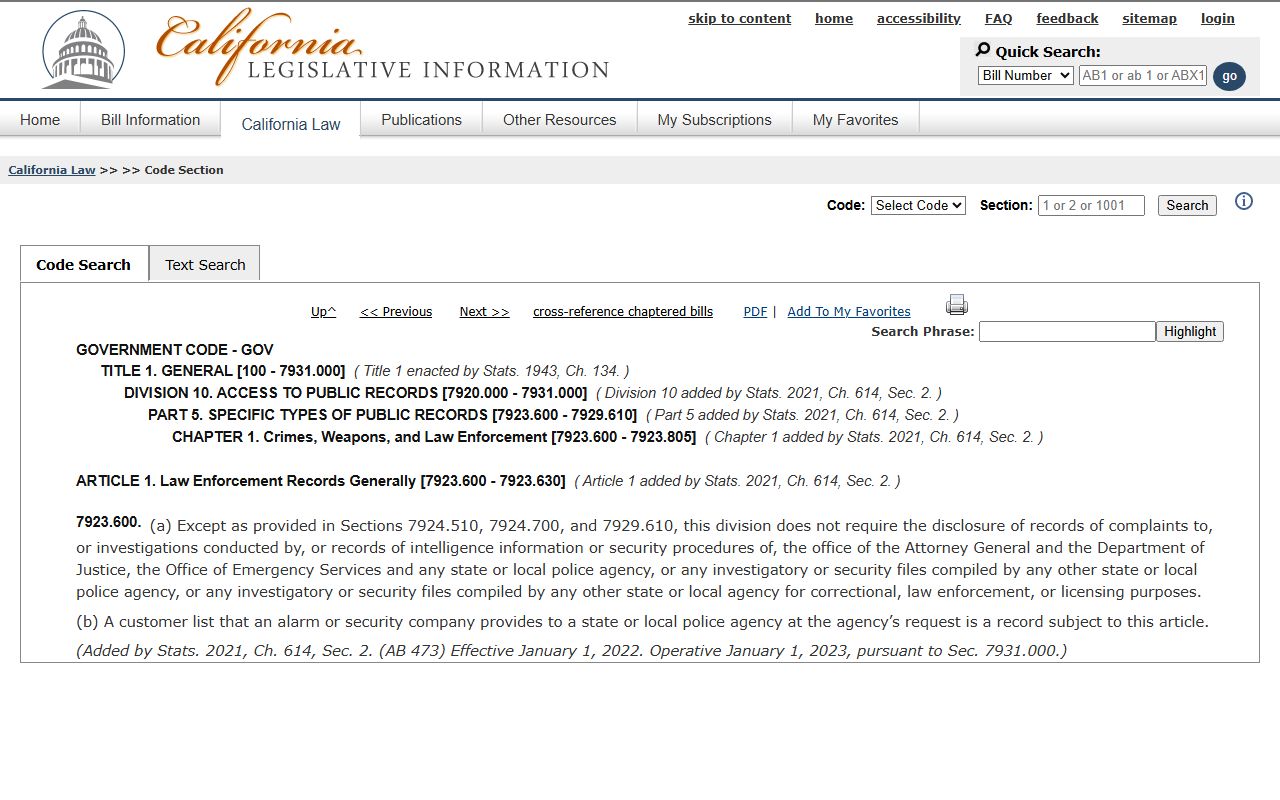
This exemption is the rule LASD points to when it declines to release an open investigation file even though the booking fact itself is public.
For full custody history on a person held in LA County, the inmate records page covers the roster fields, the booking process, and which facility holds which kind of inmate.
Public Access Laws for California Criminal Records
California uses several layers of access rules. The California Public Records Act at Government Code section 7920.000 governs records held by state and local agencies. The Act sits in Division 10 of the Government Code after the 2021 recodification that replaced the old section 6250 numbering. The Act applies to agency records such as LASD administrative files. It does not control court case records the same way. Court records are governed by constitutional access principles, the Rules of Court, and statutes that mark specific categories as confidential.
The court's PAOS pages cite Rule 2.503, which sets the general electronic-access obligation, along with Government Code section 68150 for electronic retention, and Rule 2.506 for fee authority. Sealed filings follow Rule 2.550, which requires findings before a court can seal a record. The CPRA balancing test at section 7922.000 applies on the agency side when an office weighs disclosure against privacy.
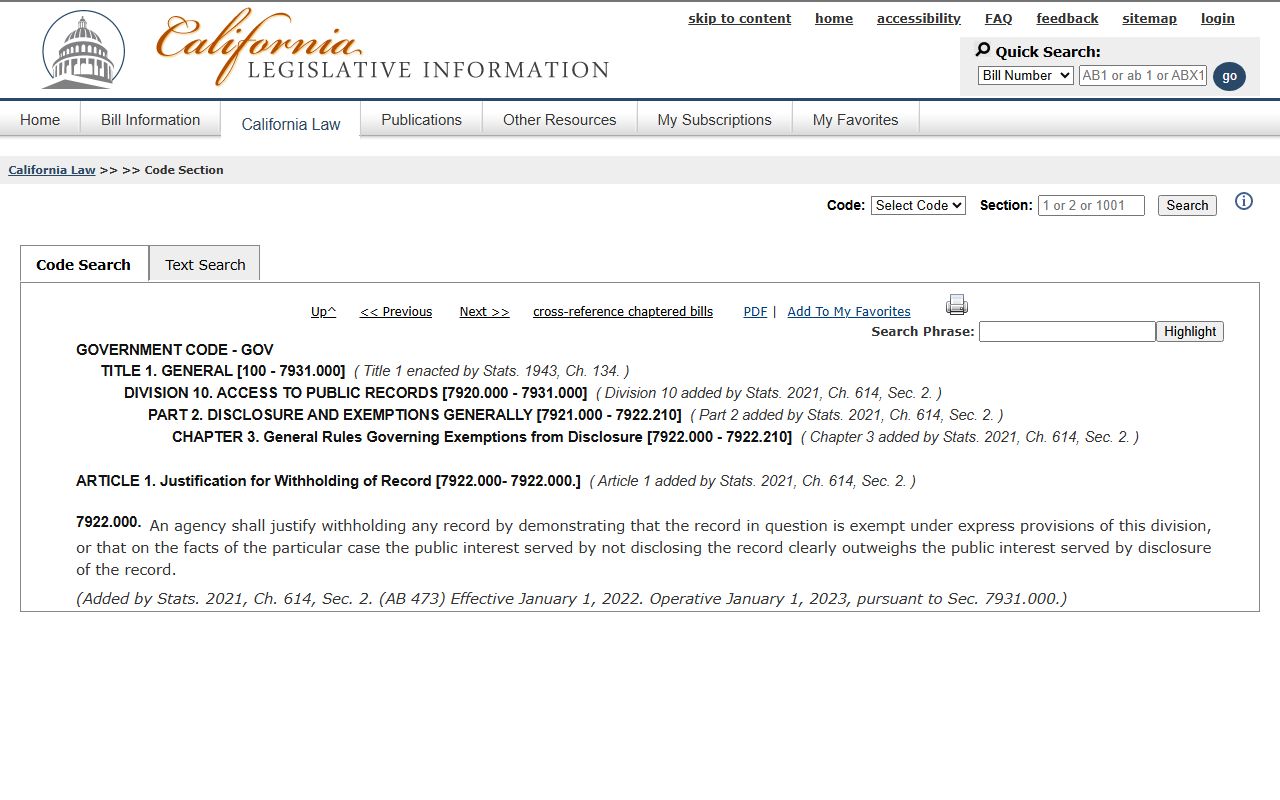
This balancing rule shows up in many denials of investigative crime reports while booking data still goes out.
Records That Are Sealed or Confidential
Some criminal data is off limits to the public no matter how a person searches. Penal Code section 851.8 covers factual-innocence sealing and destruction of arrest records. Penal Code section 851.91 covers a petition to seal an arrest when no conviction resulted. Penal Code section 851.93 covers automatic arrest relief that DOJ runs in the background for qualifying records. Juvenile case files are protected under Welfare and Institutions Code section 827.
Other categories that stay restricted include grand jury matter, sealed search warrants while under investigation, mental health diversion records, and victim address blocks. Adoption files are confidential under Family Code section 9200. Some unlawful-detainer records also carry limited access for a period after filing.
Note: A sealed arrest under section 851.91 may still be visible to certain government licensing and law-enforcement uses even after the public-side seal takes effect.
Sealed vs Expunged in California
The words sealed and expunged get used as if they meant the same thing. They do not. California sealing under section 851.91 hides the arrest record from most public access. California's main expungement relief at Penal Code section 1203.4 allows a qualifying defendant to withdraw a plea or have a verdict set aside after probation. The court then dismisses the accusations. It is not full erasure. The case still exists in court records and remains visible to certain agencies and for certain uses.
| Sealed (851.91) | Dismissed (1203.4) | |
|---|---|---|
| What It Targets | Arrest record with no conviction | Conviction record after probation |
| Public Visibility | Removed from most public views | Case still visible, marked dismissed |
| Law Enforcement | Limited access; exceptions for licensing | Available to courts and many agencies |
| Petition Form | Form CR-409 | Petition for Dismissal under 1203.4 |
| Effect on Background Check | Should not appear on most checks | Should show dismissal, not the prior plea |
True destruction of an arrest record under section 851.8 is a higher bar. The petitioner must show factual innocence. If the agency denies the request, the case can be filed in the superior court that would have had territorial jurisdiction.
How to Petition to Seal an Arrest
The California Courts self-help guide for arrest sealing names Form CR-409 as the petition to seal arrest and related records. The page links translations in Chinese, Korean, Spanish, and Vietnamese. The guide also explains that some arrests are already sealed by DOJ automatically under section 851.93. A petitioner should first check the DOJ summary of their own record before filing.
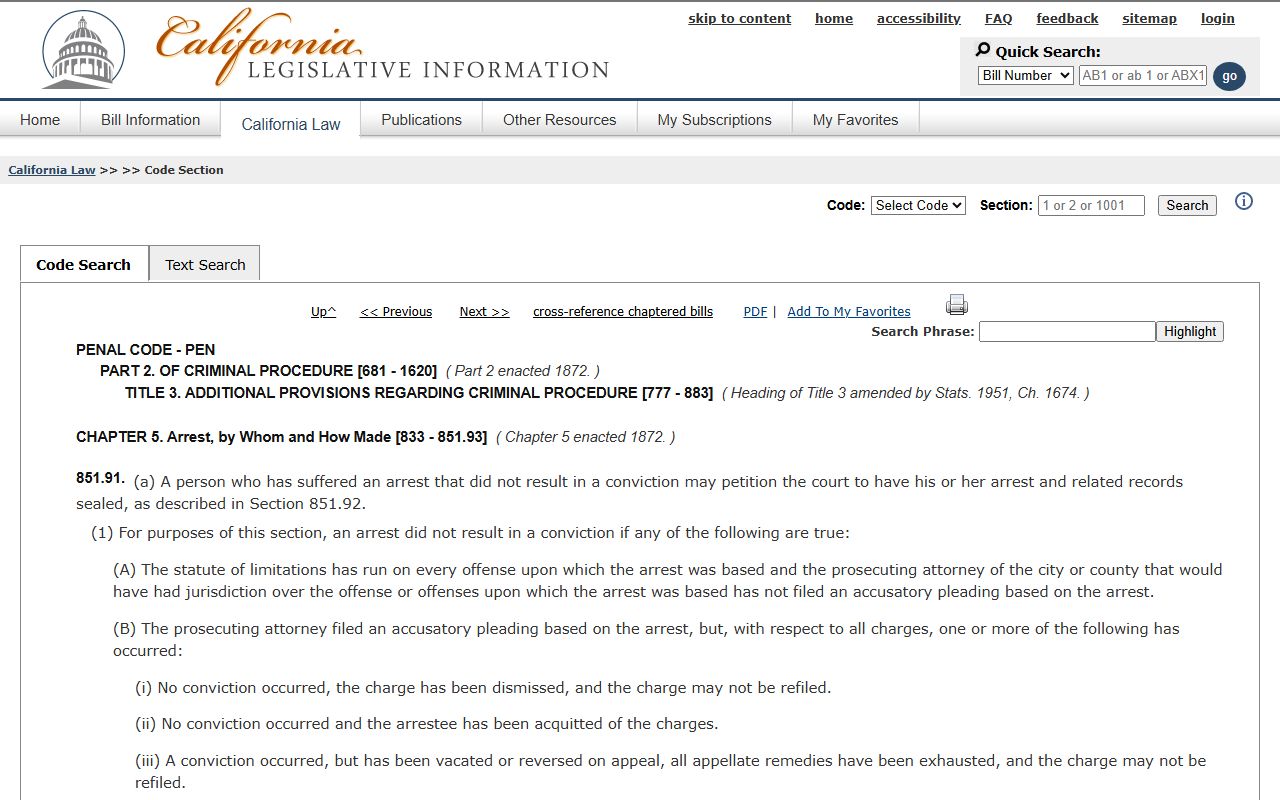
The statute is the legal basis for the public-side seal a petitioner asks the court to grant.
For factual innocence relief, the higher-standard process under section 851.8 can result in both sealing and destruction.
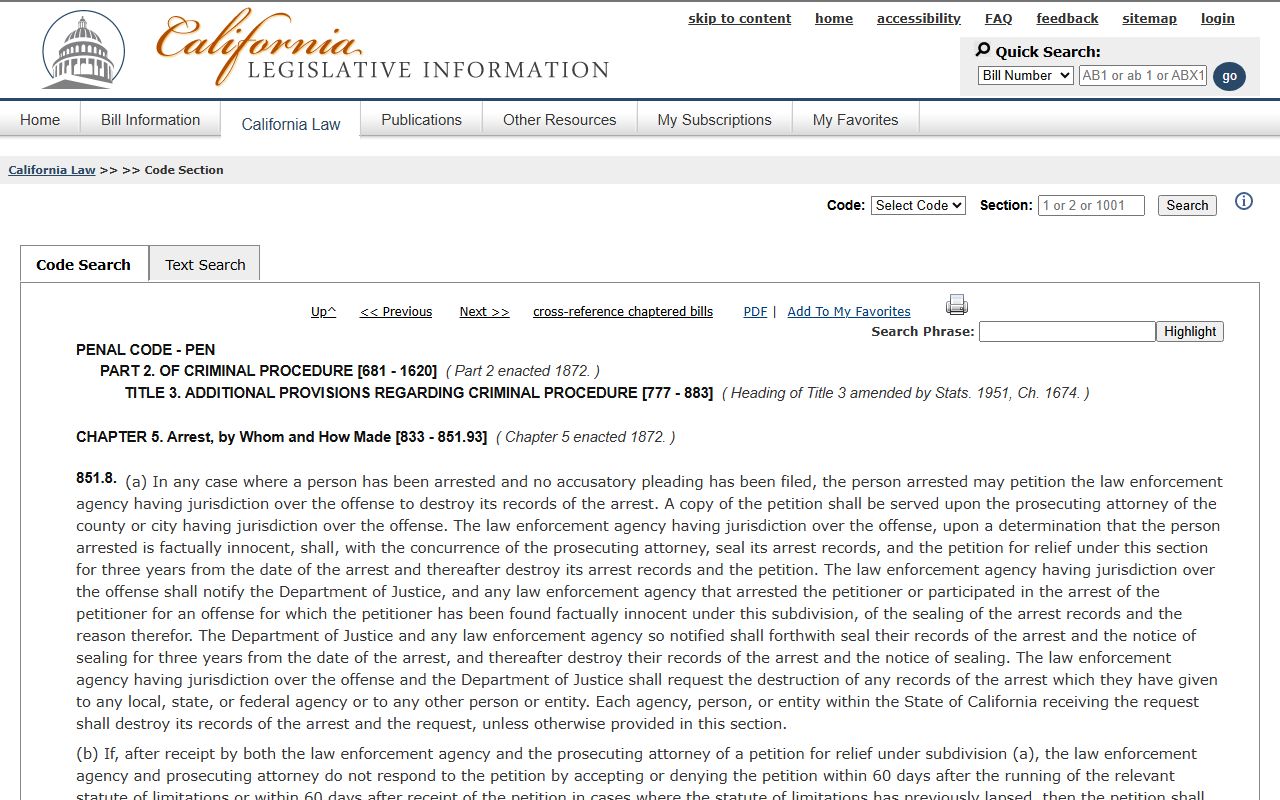
The factual-innocence path is the strongest form of relief. It is also the hardest to win.
If the relief sought is dismissal after probation, the petition follows the 1203.4 process described in the section above.
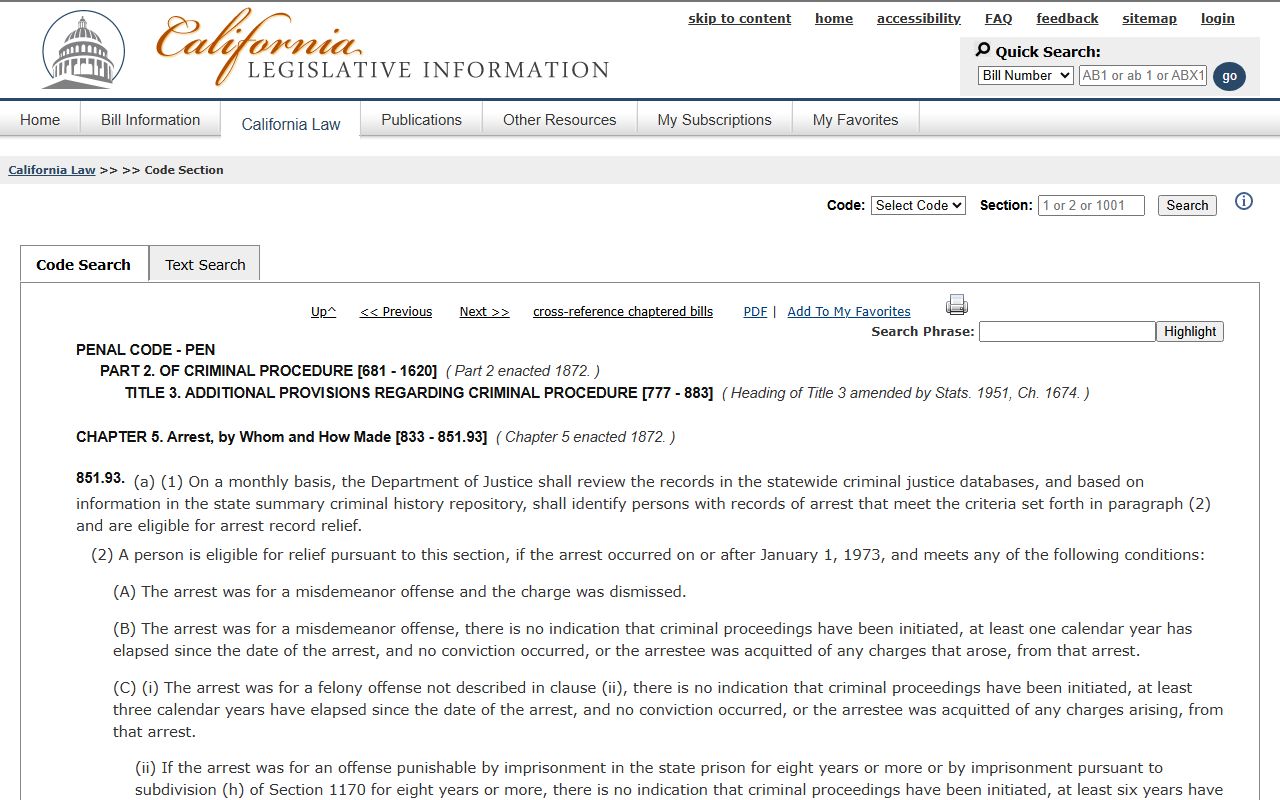
Section 851.93 is the rule behind the automatic relief DOJ already runs for some arrests, which is why a manual petition is not always needed.
The California Courts self-help clean-your-record guide walks self-represented petitioners through which path fits which fact pattern.
The LA County District Attorney and Public Defender
Criminal cases in Los Angeles County are charged by the Los Angeles County District Attorney. The current DA is Nathan J. Hochman, sworn in December 3, 2024. The office was first established by the California Legislature on February 27, 1850, and now includes nearly 300 sworn DA investigators along with victim services representatives. The DA's main offices sit in the downtown Hall of Justice area at 211 West Temple Street, Los Angeles, CA 90012. Public contact and victim services requests run through the DA contact page.
Indigent defendants in Los Angeles County are represented by the Los Angeles County Public Defender. The Public Defender services page lists Criminal Defense, Treatment Courts, Juvenile Advocacy, Immigration, Racial Justice, Mental Health, in-house social workers, and Partners for Justice client advocates. When a person qualifies, a Public Defender may be assigned at the first court appearance after a request. The Alternate Public Defender picks up cases where the main office has a conflict. Both offices appear at the criminal courthouses listed on the LA Superior Court page.
Treatment Courts inside the Public Defender's service list cover defendants whose cases tie to substance use, mental illness, or homelessness. These dockets can result in dismissal or a reduced sentence on successful completion. Eligibility is set case by case.
Federal Criminal Records
Federal crimes that took place in Los Angeles County are handled by the U.S. District Court for the Central District of California, not the Los Angeles Superior Court. Federal prosecutions are brought by the U.S. Attorney's Office for the Central District of California. The federal courthouses in downtown include the First Street U.S. Courthouse at 350 West 1st Street and the Edward R. Roybal Federal Building at 255 East Temple Street. Federal appeals go to the Ninth Circuit.
Federal criminal records are searched through PACER. PACER charges $0.10 per page, caps a single document at $3.00 for most case-specific reports, and waives quarterly fees if the user accrues $30 or less in a quarter. The cap does not apply to name-search results or transcripts. A user looking at a Los Angeles County criminal records gap that involves DUI overlap with federal land or a federal supervised release case should run a PACER name check in addition to PAOS.
For DUI cases at the state level, see the traffic court records page. For active warrants tied to a criminal case, see warrant records. For full case files including civil and probate, see court records.