
Los Angeles County Public Records Overview
Public records in Los Angeles County are spread across many offices. The Los Angeles County Registrar-Recorder/County Clerk handles real estate documents, birth and death and marriage records, fictitious business names, notary filings, and elections. The Los Angeles County Sheriff's Department keeps booking logs, custody reports, and many law-enforcement files. The Superior Court of California, County of Los Angeles holds court case files. Each agency operates under its own statute or rule. The right channel matters because asking the wrong office wastes time and may produce a "no records" letter.
Dean C. Logan oversees the RR/CC. His office records more than 2 million real estate documents each year, issues 1 million certified copies of vital records, issues 59,000 marriage licenses, and processes 20,000 fictitious business name filings. Those numbers help explain why the RR/CC is the busy hub of county public records but not the right office for divorce decrees or criminal dockets. Use the channel that matches the record. If a search comes back empty, check whether the file lives at the court instead.
California Public Records Act
California's open-records law is the California Public Records Act. It now lives in Government Code sections 7920.000 to 7931.000. The act gives the public a right to inspect or copy records held by state and local agencies. County departments, city police, sheriff offices, school districts, and special districts are all covered. The act sets time limits, fee rules, and exemptions. It also lets a court order an agency to release records if a request is denied without legal grounds.
The CPRA includes a public-interest balancing test under Government Code section 7922.000. An agency can withhold a record when the public interest in keeping it private clearly outweighs the public interest in release. That clause appears often in denials that touch active investigations, personnel files, or sensitive safety details. A requester who thinks the balance was wrong can file a verified petition in the Superior Court. The court will review the agency's claim and may order release.
The CPRA applies to county and city agencies. It does not apply to court case files. Court records have a separate access rule track. The distinction trips up many readers who assume one form fits every file.
CPRA vs Court Records: Different Channels
The CPRA covers executive and local-agency records. It does not govern court case files. Court records in California are reached through court rules and statutes that sit outside Title 1, Division 10 of the Government Code. Sending a CPRA request to the Superior Court will not produce a docket, a minute order, or a criminal case summary. Sending a Public Access Online Services (PAOS) request to the RR/CC will not produce a marriage record. The path depends on which office holds the file.
| Channel | Use For | Authority |
|---|---|---|
| LA Court PAOS | Civil, family, probate, small claims, criminal case files | Cal. Rules of Court 2.503, 2.506; Gov. Code § 68150 |
| RR/CC PRA request | Deeds, vital, FBN, notary, election admin records | Gov. Code §§ 7920.000-7931.000 |
| LASD Records and ID Bureau | Crime reports, booking info, custody PRA categories | Gov. Code §§ 7920.000-7931.000; § 7923.600 |
For court files, the PAOS guest information page explains the fee structure and the search categories. For RR/CC files, the RR/CC PRA request page takes the request directly. For sheriff files, the LASD Records and ID Bureau FAQ lists the request paths and the categories of custody data that fall under the act.
What the RR/CC Maintains
The RR/CC is the main county records office. It records and keeps a wide set of files used in everyday life. The RR/CC recorder landing page lists the main service grid: vital records, real estate, military discharge, UCC filings, recording, fees, and forms.
- Birth, death, and marriage records issued by the county.
- Recorded deeds, liens, reconveyances, and other real estate documents.
- Fictitious business name filings and searches.
- Notary oath and bond registration.
- Domestic partnership filings and professional registrations.
- UCC financing-statement requests and military discharge records.
- Marriage licenses and civil marriage ceremonies.
The RR/CC's official biography for Dean C. Logan describes the full scope of the office and the volume of its annual work.
The RR/CC online recorder page lays out which services accept online requests and which need an appointment or mail-in form.
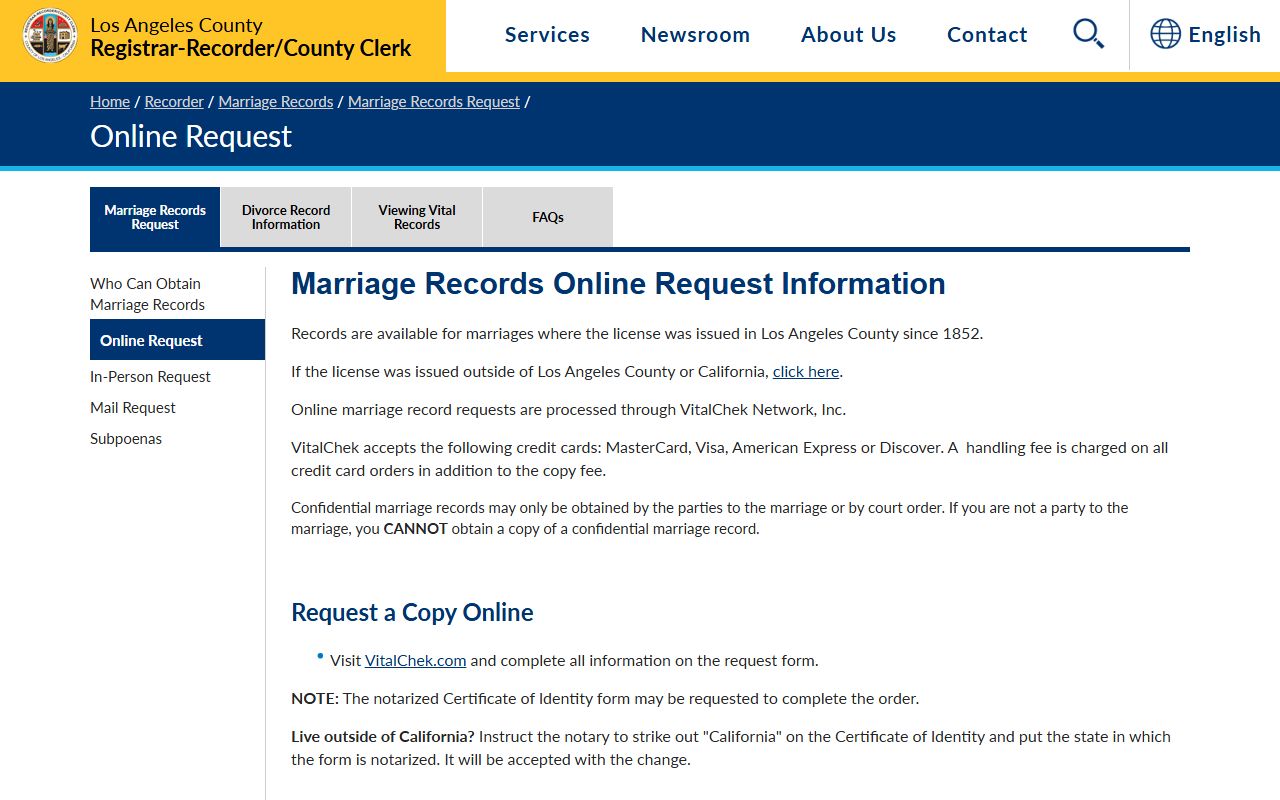
The page covers VitalChek-handled marriage-record orders, accepted card types, processing time, and the $19 fee per certified copy. It is one of the most-used public-record channels in the county.
How to File a Public Records Act Request in Los Angeles County
A clean CPRA request gets a faster response. Vague requests get clarifying questions. Use the steps below for any county or city agency. The same flow works for RR/CC administrative records and LASD records, with small format changes per office.
- Identify which office holds the record. Court files go to the Superior Court through the court records page. RR/CC admin files go to the RR/CC. Custody and sheriff files go to LASD.
- Describe the records with care. Name dates, parties, addresses, case numbers, or report numbers where possible. Vague requests slow down the search.
- State the form you want. Paper copies, certified copies, PDFs, or inspection only. Set a fee cap if cost is a concern.
- Submit through the agency's preferred channel. RR/CC uses an online PRA form. LASD uses Records and ID Bureau forms. Many city agencies accept email requests.
- Wait for the acknowledgment. The agency must reply within ten days under the CPRA. The reply may extend the deadline if the request is complex.
- Pay any direct copy fee. CPRA caps fees at the agency's direct duplication cost unless a statute sets a different fee.
- Review the released records. If items are withheld, the agency must cite the exemption. A denied request can be appealed in Superior Court.
LASD Records and ID Bureau Requests
The Los Angeles County Sheriff's Department holds many records that fall under the CPRA. Crime reports, custody statistical data, in-custody death files, and incarceration records sit in the sheriff's files. The LASD Records and ID Bureau FAQ lists the report request paths and the custody PRA categories. The department uses its own form set and its own response process.
Public PRA categories from LASD include booking information, custody incidents, custody statistical data, in-custody death records, incarceration records, inmate records, and visitation logs. Some files need a court order or a clear statutory base for release. The records FAQ explains which file goes through which channel. The department's custody reports page publishes recurring releases and inspection reports that do not require a PRA filing at all.
Note: LASD records related to active investigations may be withheld until the case is closed or until release would not impair the investigation.
Law-Enforcement Investigatory Records Exemption
California protects active investigation files. The CPRA at Government Code section 7923.600 lets a law enforcement agency withhold investigatory records that would impair a criminal case or harm a person's safety if released. The LASD FAQ still cites the older Government Code section 6254(f) language, but the current rule lives in the 7923 range. The release of certain basic facts is still required by law, such as the names of arrested adults, charges, and bail amount, with some narrow safety carve-outs.
The exemption is not unlimited. A blanket "investigatory" label does not protect every file forever. After a case ends, much of the file may be releasable, with redactions for victims, witnesses, juvenile suspects, and confidential informants. Courts review claims when a requester challenges a denial. The Penal Code also creates separate carve-outs that affect the release of arrest records under Penal Code section 851.91.
Court Records Are Not Covered by CPRA
Court case files in Los Angeles County are not CPRA records. Access goes through the court's own rules and statutes. The two main authorities are California Rule of Court 2.503 for electronic access to trial court records and Government Code section 68150 for trial court records and electronic retention. Rule 2.503 says court records must be reasonably available in some form unless a record is sealed by court order or made confidential by law. Section 68150 lets the court keep records electronically and underlies the court's online fees.
The practical route for court records is the LA Superior Court's Public Access Online Services system. PAOS supports name searches in civil, family, probate, and small claims; defendant searches in criminal; and document-image downloads where the case type and date range are covered. The court charges per search and per page under Rule 2.503 and the related fee rule. For older court records, the court directs users to Archives or to the courthouse handling the case. See the Clerk of the Superior Court page for paper copy paths.
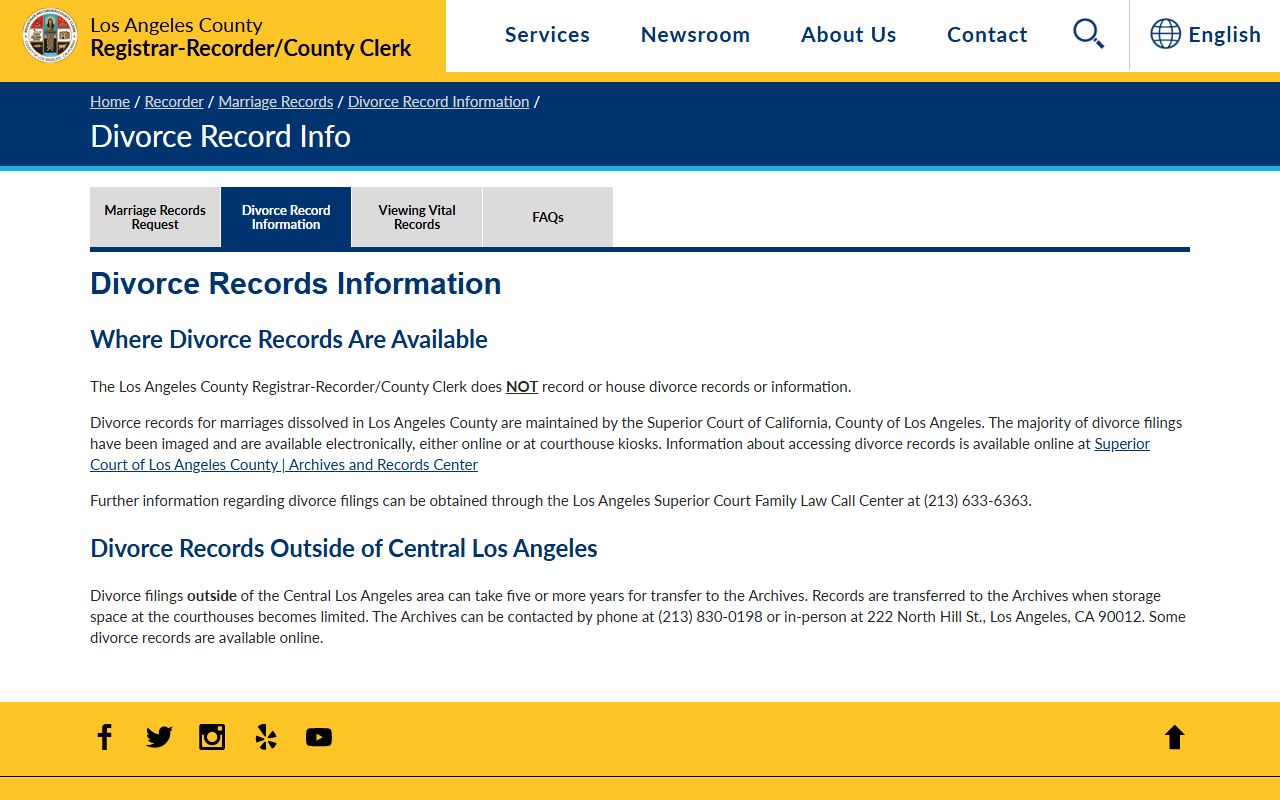
The RR/CC's divorce-records page is a good example of the split. It directs users away from the RR/CC and over to the Superior Court for the actual decree and case file. The same rule applies to many other county records that look like they should sit with the county clerk but actually live in court.
Fees and Copy Costs
Different offices charge different amounts. RR/CC fees, court fees, and sheriff fees all run on separate schedules. The CPRA caps general agency copy charges at the direct cost of duplication unless a statute sets a higher fee. Certified copies usually cost more because the office must add the certification process. The table below shows common Los Angeles County records fees.
| Item | Amount | Source |
|---|---|---|
| Certified copy of court record | $25 per copy plus copy fee | Gov. Code § 70626(b)(1) |
| Plain court copy per page | $0.50 per page | Gov. Code § 70627 |
| PAOS guest name search | $4.75 per search | LA Court PAOS schedule |
| PAOS document image (pages 1-5) | $1.00 per page | LA Court PAOS schedule |
| PAOS document image (page 6+) | $0.40 per page | LA Court PAOS schedule |
| PAOS document image cap per file | $40.00 | LA Court PAOS schedule |
| Certified marriage record (public) | $19 | RR/CC online request |
| Certified marriage record (confidential) | $19 | RR/CC online request |
| RR/CC real-estate copies | Varies by document type | RR/CC fee schedule |
The RR/CC property document recording fees page lists the exact rates for recorded real estate copies.
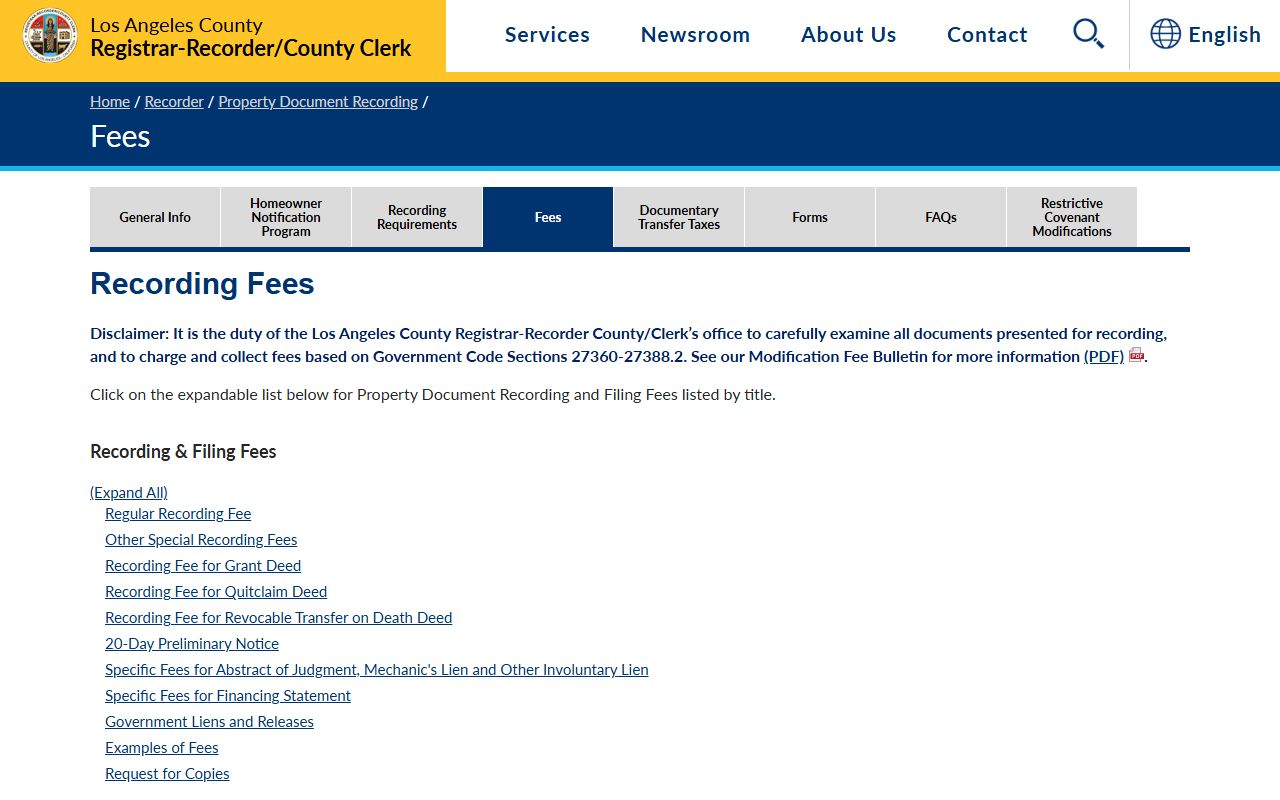
That page is the most current source for recording fees and copy costs at the RR/CC. Check it before mailing a check.
Response Timelines
The CPRA sets the basic clock. An agency must reply within ten days of a request. The reply tells the requester whether the records exist and whether they will be released. The agency can extend the deadline by up to fourteen days when the request is unusual, when the office must search separate locations, or when the office must consult with another agency. The reply must explain any exemption claimed.
Court files run on a different clock. PAOS searches return results in real time, but the results are limited by case type and date. Document images are returned by the system within seconds of payment. Older paper files may take days or weeks. The court warns that PAOS name-search results stay available for two hours after the transaction, and purchased documents stay available for thirty days. The RR/CC online real-estate copy request page states that orders are processed within twenty working days from the date received.
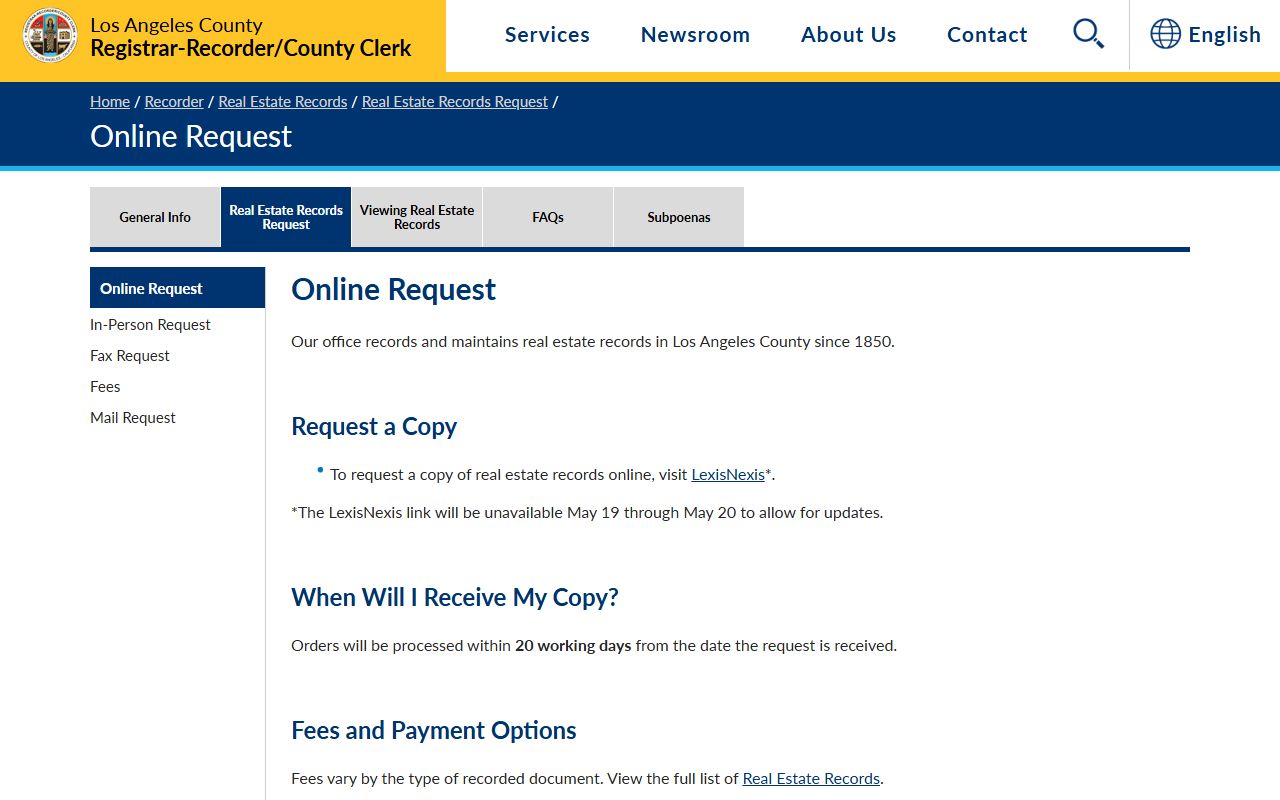
That same page also notes that LA County real estate records go back to 1850, which is the deepest archive in the county records system.
Public Records vs Confidential Records
Not every record is open. California limits access for many categories. Juvenile case files are restricted under Welfare and Institutions Code section 827. The statute lets the parties, attorneys, and certain agencies see the file but blocks the general public. Adoption records are confidential under Family Code section 9200. Sealed records use California Rule of Court 2.550, which sets the legal standard before a court may seal any file.
Confidential marriage records are unusually narrow. The RR/CC issues those only to the parties to the marriage or by court order. Informational copies are not issued for confidential marriage files at all. Mental health proceedings, certain unlawful detainer matters, and grand jury material also fall outside the public record category. Crime victim information is often redacted. Social Security numbers and financial account numbers are redacted in court filings under court rules and California Code of Civil Procedure provisions.
Note: A record can be partly public and partly sealed; the open parts must still be released with the sealed parts withheld.
Federal FOIA is Not a State Tool
The federal Freedom of Information Act covers federal agencies only. It does not reach Los Angeles County offices, the Superior Court, the sheriff, or city departments. A FOIA request mailed to the RR/CC will be returned with a note about CPRA. A FOIA request mailed to the Superior Court will not produce a court file. Federal records, such as FBI files or federal prosecution records, go through the agency's FOIA office or the National Archives.
Federal court records are reached through PACER for the Central District of California and the Ninth Circuit. Those records are not CPRA records and are not FOIA records. PACER charges $0.10 per page with a $3.00 document cap for most docket items, and waives quarterly fees of $30 or less. For state court files in Los Angeles County, the channel is always LA Court PAOS or the courthouse, not a federal tool.