
How to Search Los Angeles County Court Records
The Superior Court of California, County of Los Angeles runs all case search through one portal. It is called Public Access Online Services, or PAOS. PAOS holds three core tools. A name search for civil, family, probate, and small claims cases. A defendant name search for criminal cases. And a document image search that pulls scanned PDFs once a case number is known. Each tool charges a fee. The court cites California Rule of Court 2.506 and Government Code section 68150 as authority to charge for online access. Name search results stay live for two hours. Purchased documents stay live for thirty days.
The system updates daily. New filings, hearings, and dispositions may not show right away. Before starting, get the party name spelled the way it appears on file. A case number speeds things up. Have a card ready for the fee.
The official LA Superior Court homepage is the main entry point for the records system. The screenshot below comes from the court's primary site and shows the redesigned 2025 layout. It links jury, forms, self-help, court divisions, and online services.
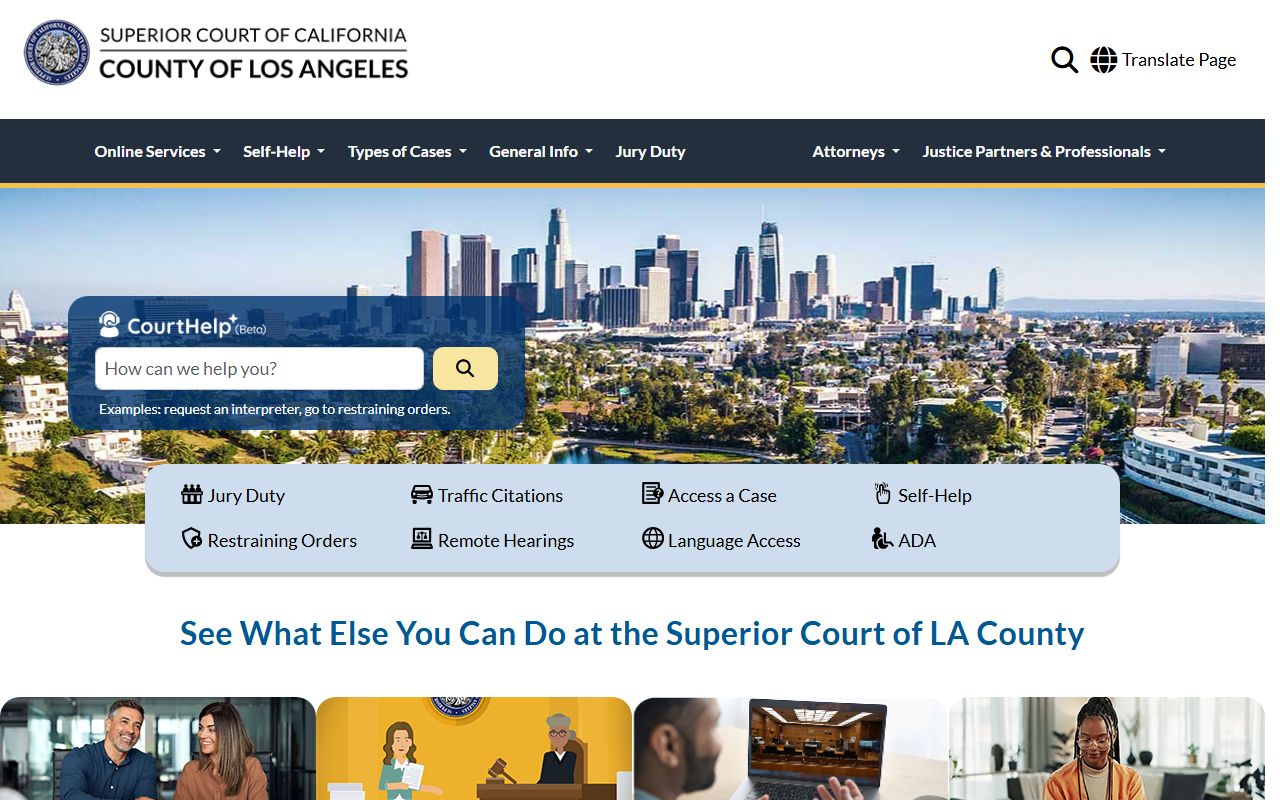
Use that homepage to confirm court news, courthouse hours, and access notices before each visit.
- Decide which case track you need. Civil, family, probate, and small claims sit in one search. Criminal sits in another. Traffic and other infractions are excluded and route to the Traffic Division.
- Open the PAOS civil name search or the PAOS criminal name search. Pick guest checkout for a one-off lookup, or sign in if you run many searches each month.
- Type the party or defendant name. Civil results show case type, filing date, filing location, and the count of imaged documents. Criminal results show case number, defendant, filing date, and filing location.
- Note the case number from the result list. That number unlocks the case summary view and the document image search.
- Buy the documents you need. Pages 1 to 5 cost $1 each. Pages 6 and after cost $0.40. The cap is $40 per document.
- Save or print right away. Name results expire after two hours; purchased PDFs hold for thirty days.
The Los Angeles County Judicial System
California unified its trial courts in 1998. Each county now runs one Superior Court. There is no separate state district court, no county court at law, and no justice court at the state level. The California Judicial Branch describes three levels: the Supreme Court, the Courts of Appeal, and the Superior Courts. The state has 58 trial courts, one in each county. The state has six appellate districts.
Los Angeles County is served by the Superior Court of California, County of Los Angeles. Appeals from this court go to the California Court of Appeal, Second Appellate District. The state Supreme Court takes discretionary review after that. The local court also runs its own Appellate Division for misdemeanor, infraction, limited civil, and small claims post-judgment matters. That division sits at Stanley Mosk Courthouse, 6th Floor, Room 607.
The court groups legal matters into nine divisions. Appellate, Civil, Criminal, Family Law, Juvenile, Mental Health, Probate, Small Claims, and Traffic. Court business is spread across 36 courthouses in 12 judicial districts: Central, East, North, North Central, North Valley, Northeast, Northwest, South, South Central, Southeast, Southwest, and West. The full courthouse roll is on the courthouse browser page, which is shown below.
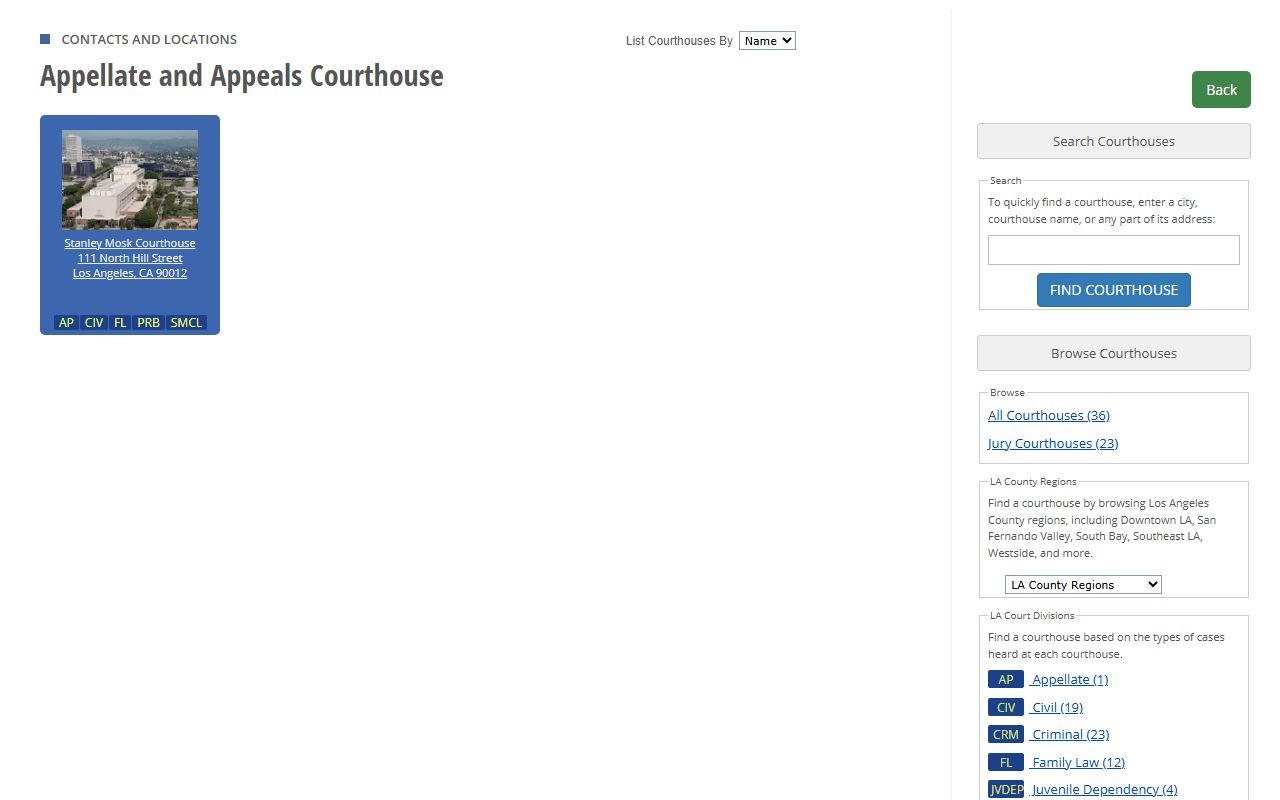
Use the browser to find which courthouse hears each case type, then check filing location on PAOS before mailing or visiting.
Case flow: Superior Court trial › LA Appellate Division (limited civil, misdemeanor, infraction, small claims) › California Court of Appeal, Second Appellate District › California Supreme Court.
| Court | Jurisdiction | Case Types |
|---|---|---|
| California Supreme Court | State high court | Discretionary review; mandatory death-penalty review |
| California Court of Appeal, Second Appellate District | Appeals from LA Superior Court | Civil, criminal, family, probate appeals |
| LA Superior Court Appellate Division | Local appeals from limited cases | Misdemeanor, infraction, limited civil, small claims post-judgment, writs |
| Superior Court of California, County of Los Angeles | Trial court for the county | Civil, criminal, family, probate, juvenile, mental health, traffic, small claims |
The court browser also gives division counts. Criminal sits at 23 courthouses. Civil sits at 19. Traffic sits at 17. Family law sits at 12. Small claims sits at 12. Juvenile justice sits at 7. Juvenile dependency sits at 4. Mental health and probate each sit at 2. The Appellate Division sits at 1.
| Path | Superior Court | Appellate Division |
|---|---|---|
| Felony case | Trial at criminal courthouse | Appeal goes to Second Appellate District, not the local Appellate Division |
| Misdemeanor case | Trial at criminal courthouse | Appeal goes to LA Appellate Division |
| Limited civil case | Trial at civil courthouse | Appeal goes to LA Appellate Division |
| Unlimited civil case | Trial at civil courthouse | Appeal goes to Second Appellate District |
| Small claims post-judgment | Hearing at small claims courthouse | Review by LA Appellate Division |
More on the local trial court is on the Superior Court page. Clerk duties sit on the Clerk of the Superior Court page.
Which Office Holds Which Los Angeles County Record
This is where most search trouble starts. The Superior Court and the county Registrar-Recorder/County Clerk both work in records, but they hold different files. The Superior Court holds case files. The Registrar-Recorder/County Clerk, called RR/CC, holds vital records, real estate filings, marriage licenses, fictitious business names, notary filings, and elections. Sheriff Robert G. Luna's LASD holds custody and arrest information. The District Attorney holds prosecution files.
Court case files live with the court. That covers civil complaints, criminal dispositions, family law judgments, divorce decrees, probate orders, small claims judgments, juvenile case files (restricted), and mental health proceedings. Marriage records live with RR/CC. Divorce decrees do not. The RR/CC site states that divorce decrees are Superior Court records and points users to the court. That single point catches a lot of users off guard.
- Civil and probate case files live with the Superior Court and are searched on PAOS.
- Criminal case files live with the Superior Court; the DA holds prosecution work product.
- Marriage records live with RR/CC; divorce decrees live with the Superior Court.
- Probate records live with the Superior Court probate division.
- Inmate records and warrant information live with LASD and the court case file.
- Public records for county agency files use the California Public Records Act process, not PAOS.
Dean C. Logan is the current Registrar-Recorder/County Clerk. His office records more than 2 million real estate documents, issues 1 million certified vital-record copies, and issues 59,000 marriage licenses each year. The headquarters sit at 12400 Imperial Highway, Norwalk, CA 90650. None of those filings are court dockets.
Types of Court Records Available in Los Angeles County
The Superior Court holds many record types. Each one sits in a different division. Coverage years and online access also differ. The court's CivilIndex page lists name search back to 1983 for unlimited civil, probate, and family law. Limited civil goes back to 1991. Small claims goes back to 1992. Criminal name search runs back to 1980 for felony and 1988 for misdemeanor.
- Civil records - complaints, answers, motions, judgments, writs, and abstracts. Searched through PAOS by party name.
- Criminal records - complaint, information, arraignment minutes, plea, bail order, sentencing minute, and disposition. PAOS criminal search returns case number, defendant name, filing date, and filing location.
- Family law records - dissolution petitions, custody orders, support orders, parentage, and restraining orders. Some files include sealed material.
- Probate records - petitions, wills, letters, accountings, guardianships, conservatorships, and final distribution orders.
- Traffic records - citations, plea, fines, traffic school status, and failure-to-appear actions. Not in the criminal name search.
- Small claims records - plaintiff's claim, defendant's claim, judgment, and enforcement orders.
- Juvenile records - restricted under Welfare and Institutions Code section 827.
Unlawful detainer files are limited civil. Some access is restricted by California law during certain windows. Mental health files include LPS conservatorships and CARE proceedings, with broad privacy limits. Adoption files are confidential under Family Code section 9200.
For a fuller list and the docket layout, see the court dockets page.
What Los Angeles County Court Records Show
A search result on PAOS shows a short index entry. The full record sits inside the case file. The court's CivilIndex page describes the result fields. The screenshot below comes from that same page and lists what the civil, family, probate, and small claims search returns.
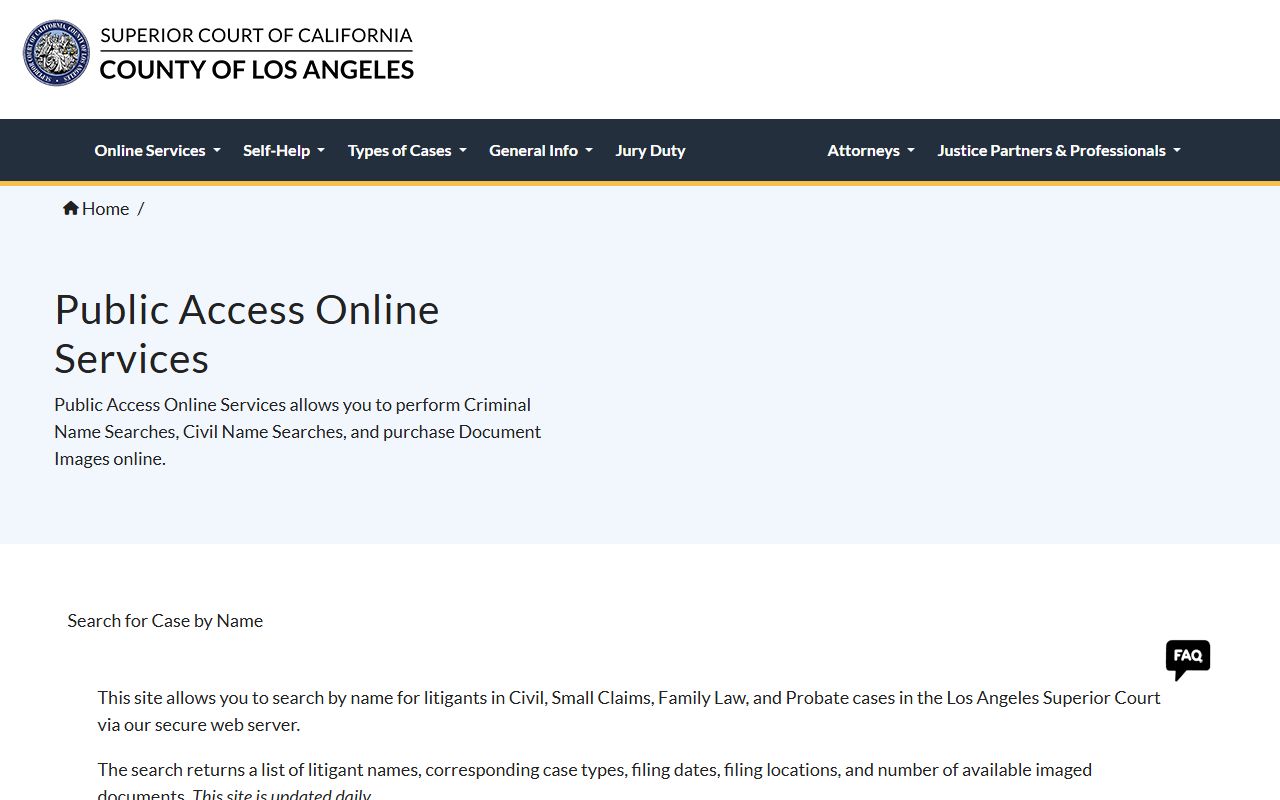
Read the page once before each search. The fee schedule and date ranges are right there.
| Field | What It Shows |
|---|---|
| Case Number | Court file identifier; required for document images and case summaries. |
| Case Type | Civil, family, probate, small claims, felony, or misdemeanor track. |
| Filing Date | Date the case opened in the court system. |
| Filing Location | Which Los Angeles County courthouse holds the file. |
| Parties | Civil search returns litigant names; criminal search returns defendant name. |
| Document Count | Number of imaged documents available for purchase. |
| Disposition / Status | Pending, disposed, dismissed, judgment entered, sentenced, sealed. |
The case file holds more. Inside the docket sit each motion, hearing date, courtroom, judicial officer, ruling, and notice. Minute orders are the clerk's summary of what happened in court. Sealed filings stay out of the public view. Social Security numbers and financial account numbers are redacted under court rules.
PAOS Search Fields for Los Angeles County Court Records
The criminal and civil search pages share a similar form layout. The static page does not expose every field label, but the public-facing material confirms the core inputs. The screenshot below is from the criminal defendant search page; it also lists the felony and misdemeanor coverage years.
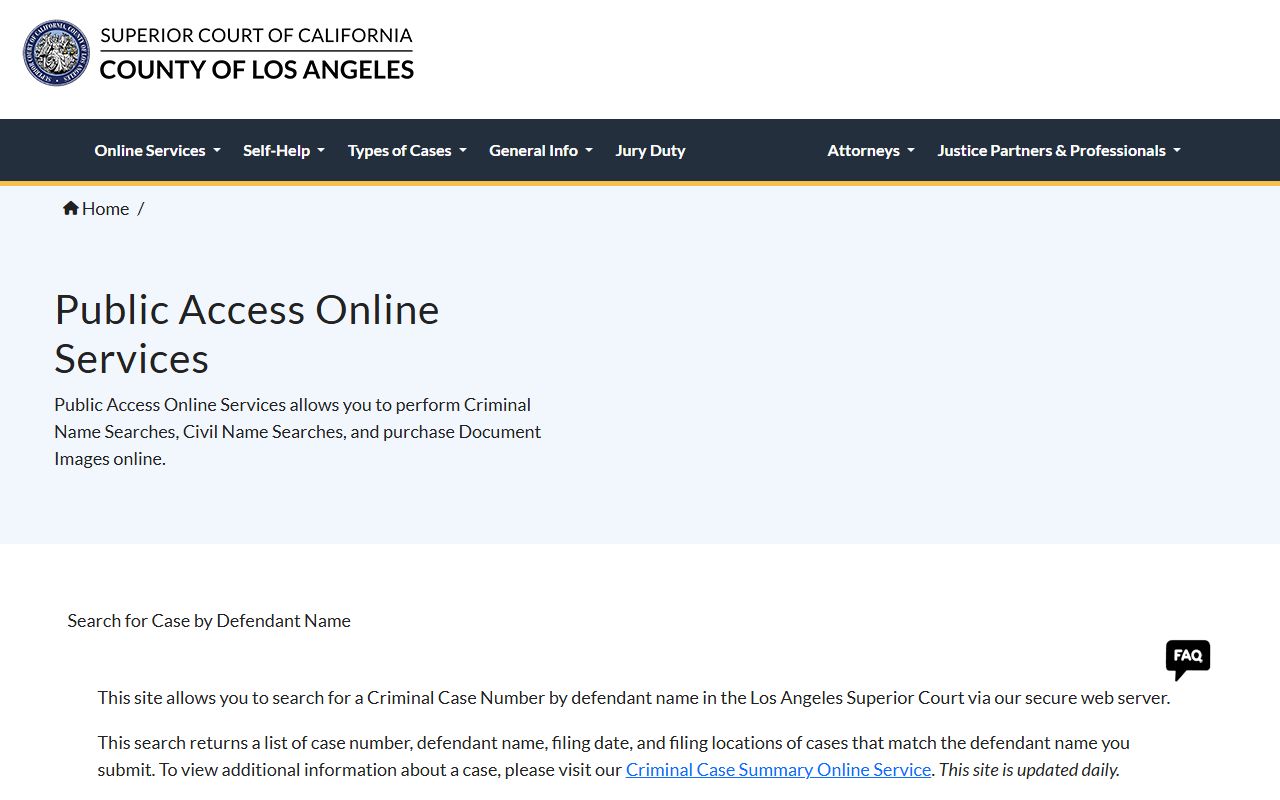
That page is the start for any criminal case lookup by name.
| Field Label | Type | Required | Notes |
|---|---|---|---|
| Party / litigant name | text | yes | Civil, family, probate, small claims tracks share one search. |
| Defendant name | text | yes | Criminal tracks split felony and misdemeanor by year coverage. |
| Case category | service | yes | Civil/family/probate/small claims OR criminal. |
| Guest or registered user | choice | yes | Sets the fee tier. |
| Receipt Number | text | optional | Used to retrieve past guest results. |
| Last 4 of credit card | text | optional | Used with receipt number to pull past results. |
| Search button | action | yes | Runs the lookup inside the transaction flow. |
For document images, only the case number search applies. Page fees apply. The court warns that confidential or courtroom-filed documents may not appear online.
Los Angeles County Court Records Fees
The LA Superior Court charges for name search, document image search, and certified copy work. The fee tier depends on whether the user is a guest or a registered user. The PAOS Guest Information page sets out the schedule. The screenshot below comes from that same page.
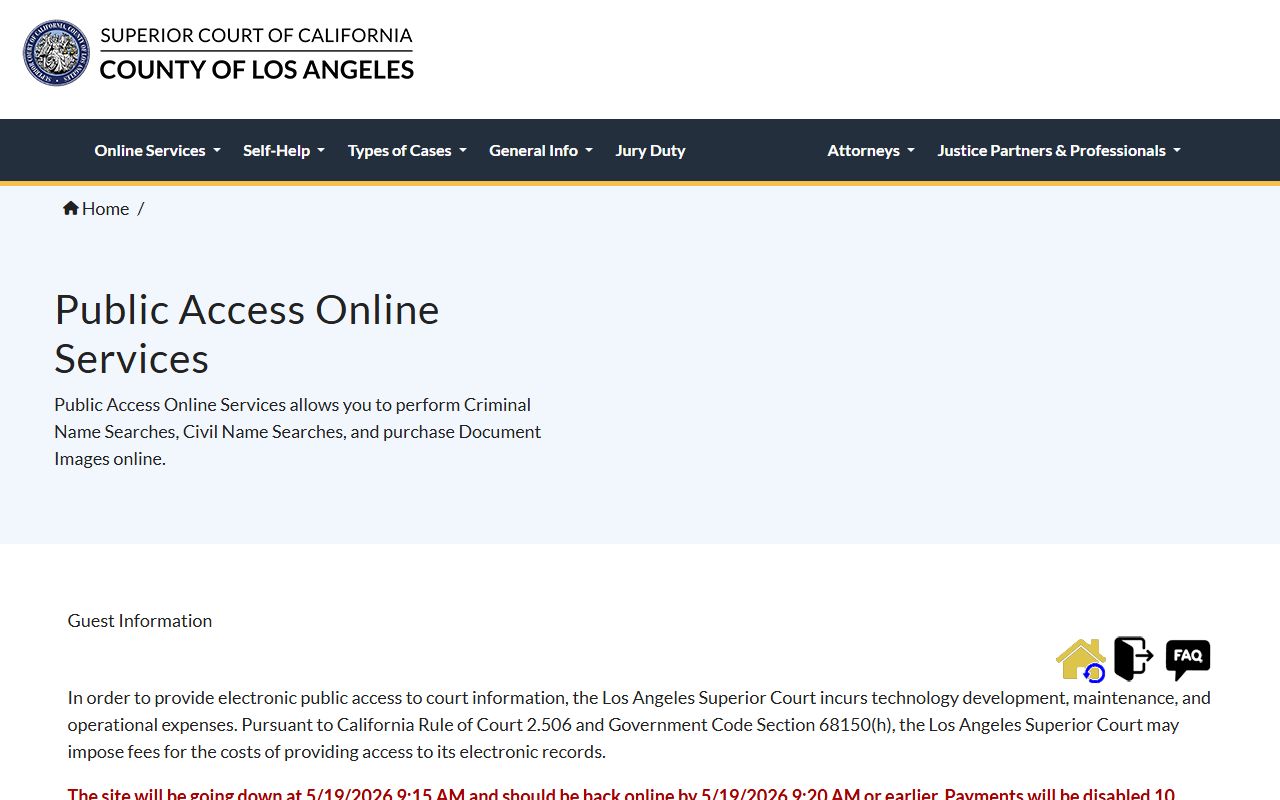
It also tells users that name search results stay live for two hours and that purchased PDFs stay live for thirty days.
| Item | Amount |
|---|---|
| PAOS guest name search | $4.75 per search |
| Registered user, 1 to 10 searches | $1.00 per search |
| Registered user, 11 to 99 searches | $4.75 per search |
| Registered user, 100 to 999 searches | $4.50 per search |
| Registered user, 1,000 to 10,000 searches | $4.25 per search |
| Registered user, 10,001+ searches | $4.00 per search |
| Document image, pages 1 to 5 | $1.00 per page |
| Document image, page 6 and after | $0.40 per page |
| Document image maximum per document | $40.00 |
| Certified public marriage record (RR/CC) | $19.00 |
| Certified confidential marriage record (RR/CC) | $19.00 |
Stanley Mosk Courthouse, Room 112 handles certifications and copies of court records in person. The phone line for civil clerical service is (213) 830-0803, with hours 8:30 a.m. to 4:30 p.m. Fees for in-person certified copies follow statewide schedules and can be checked at the clerk window.
Public Access Laws for Los Angeles County Court Records
California uses two main access tracks. Local and state agency records follow the California Public Records Act. Court case records follow constitutional access rules, the California Rules of Court, and specific statutes that protect some files. The court relies on Rule of Court 2.506 and Government Code section 68150 to charge for electronic access. Rule 2.503 sets the general electronic-access duty. Rule 2.550 controls sealed records.
Key Statutes:
Cal. Gov. Code § 7920.000 - Names the California Public Records Act. Sets the framework for access to county and state agency records.
Cal. Gov. Code § 7922.000 - Lets an agency withhold a record when the public interest in keeping it out clearly outweighs the public interest in disclosure.
Cal. Gov. Code § 7923.600 - Limits release of law enforcement investigatory records while still requiring release of booking and arrest information.
Cal. Gov. Code § 68150 - Lets trial courts keep records in electronic form and supports cost recovery for electronic access.
Cal. Rule of Court 2.550 - Sets the test a court must apply before sealing a record: overriding interest, prejudice without sealing, narrow tailoring, and no less restrictive means.
Penal Code section 851.91 sets the path to seal an arrest record when no conviction follows. Section 851.93 sets up automatic relief for some arrests. Section 1203.4 gives dismissal relief after probation. These statutes change what shows up on a criminal record, but they do not erase every trace.
Records That Are Restricted or Confidential
Not every Los Angeles County court record is public. Some are sealed by law. Others are sealed by court order. Some can be unsealed only by petition. Juvenile dependency and delinquency files sit under Welfare and Institutions Code section 827. Public access to those files is the exception, not the rule. Adoption files are confidential under Family Code section 9200. Sealed civil, family, probate, and criminal filings follow Rule of Court 2.550.
Arrest records may be sealed under Penal Code section 851.8 (factual innocence), section 851.91 (petition after no conviction), or section 851.93 (automatic relief). The court self-help center lists Form CR-409 for the petition to seal arrest records. Some unlawful detainer files have limited public access for a set window after filing or by case outcome. Mental health proceedings, victim address fields, and grand jury work product are restricted by other rules.
To view a sealed record, a party usually needs to file a motion. The motion must meet the Rule 2.550 test. The order to unseal is rare without a strong showing.
Specialty Courts in Los Angeles County
LA Superior Court runs several treatment and problem-solving programs. Mental Health is one of the nine official divisions and sits at two courthouses. CARE Court, LPS conservatorship, and competency-related proceedings flow through that division. Treatment Courts are listed by the Los Angeles County Public Defender as a service category for clients with substance use disorders, mental illness, or other treatment needs.
Juvenile Justice and Juvenile Dependency divisions run their own dockets for delinquency and child welfare cases. The records there are restricted by law. The Family Law Division handles domestic violence restraining order calendars in addition to dissolution work. Veterans court and other collaborative court rosters change over time; the court's current division pages should be checked before naming a specific courtroom.
Los Angeles County Sheriff and Jail Information
Sheriff Robert G. Luna is the 34th Sheriff of Los Angeles County. LASD describes itself as the largest sheriff's department in the United States, with nearly 18,000 budgeted sworn and professional staff. The custody side runs Men's Central Jail, Twin Towers Correctional Facility, Inmate Reception Center, North County Correctional Facility, the Pitchess East/North/South facilities, and Century Regional Detention Facility for women.
The LASD Inmate Information Center is the public lookup tool. Search fields include last name, first name, middle name, and date of birth, gated by reCAPTCHA. Bookings made within the last two hours do not yet appear. LASD lists (213) 473-6100 for general custody help and (213) 473-6002 for the Inmate Answering Service. Public inmate fields include booking details, arrest information, bail amount, housing location, court dates and location, release date, holds, and visiting days and hours.
For the full roster guide, see the Los Angeles County inmate records page. For releases, see the released inmates page. For population data, see the jail population page. For warrants tied to a case, see the warrant records page. Los Angeles County District Attorney Nathan J. Hochman, sworn in December 3, 2024, leads prosecution under the DA office.
Marriage, Divorce, and Probate Records
Marriage licenses and certified marriage copies live with the Los Angeles County RR/CC. Couples complete an online application, save the confirmation number, book an appointment, and bring valid photo ID. Marriage records cover licenses issued in Los Angeles County since 1852. The fee for a certified public or confidential marriage record is $19. Online orders go through VitalChek with a handling fee.
Divorce decrees are different. They are Superior Court records, not RR/CC records. Family law name search on PAOS goes back to 1983, and document images go back to May 1, 2000. Confidential portions of family files may be sealed by law or by order. More detail sits on the marriage and divorce records page.
Probate name search runs back to 1983; probate document images run from January 1, 2001. The court lists probate at Stanley Mosk Courthouse and Michael Antonovich Antelope Valley Courthouse. The 2026 general order on probate e-filing was signed by Presiding Judge Sergio C. Tapia II. Probate covers wills, letters testamentary, accountings, guardianships, and conservatorships. Common terms below help when reading a probate docket. The full guide sits on the probate records page.
- Testator
- A person who writes a will.
- Executor
- The person named in a will to manage the estate.
- Intestate
- A person who dies without a valid will.
- Guardian
- A person appointed by the court to care for a minor or their estate.
- Conservator
- A person appointed to care for an adult who cannot manage themselves.
- Petitioner
- The person who asks the court to open probate.
California Probate Code section 8000 sets out the petition for administration. Section 13100 sets the small-estate affidavit threshold.
How to Read Los Angeles County Court Records
Court records use shorthand. The docket, also called the register of actions, runs in date order. Each line is a filing or a court event. A motion is a written request to the judge. An opposition is the response. A reply is the moving party's answer to the opposition. A minute order is the clerk's note of what happened at a hearing. A judgment is the court's final decision on the claims.
One key point catches readers off guard. A charge is not the same as a conviction. A criminal docket may show charges that were dropped, dismissed, or reduced. Read the disposition before drawing a conclusion. A disposition of "dismissed" means the case ended without a conviction. A disposition of "guilty" or "no contest" means a conviction. A disposition of "diversion" or "pretrial intervention" means the case may end in dismissal after treatment or other conditions.
- Plea - the defendant's response to the charge: guilty, not guilty, or no contest.
- Sentence - the punishment imposed after a conviction.
- Bail - money or security to secure release and court appearance.
- Continuance - a postponement of a hearing or deadline.
- Writ of possession - an order used in eviction cases to allow the sheriff to take possession.
- Dismissed with prejudice - the claim or charge cannot be refiled.
- Dismissed without prejudice - the matter may be refiled.
Note: California Penal Code section 1203.4 lets some defendants withdraw a plea after probation, but it does not erase the underlying file.
Accuracy, Updates, and Record Limitations
The PAOS civil and criminal index pages each say the site is updated daily. That means a new filing may not show right away. Hearings get continued. Dispositions get entered after the order is signed. Custody and release data on the LASD Inmate Information Center lags by two hours after each booking. Web status is never a substitute for a direct check with the clerk for time-sensitive matters.
Older cases may live only on paper or microfilm. If a case predates the PAOS coverage window, the file may be in Archives or at the original courthouse. Civil and probate name search goes back to 1983. Limited civil starts in 1991. Small claims starts in 1992. Felony criminal starts in 1980. Misdemeanor starts in 1988. For anything older, call the courthouse and ask about Archives.
Note: Always confirm court dates, bail amounts, and release timing through the clerk or the LASD custody line before acting on a result from the public portal.
Federal Court Records in Los Angeles County
Federal cases do not sit in the Superior Court. They live in the U.S. District Court for the Central District of California. Federal criminal, civil rights, federal-question, and diversity matters all run through that court. The U.S. Bankruptcy Court for the Central District of California handles bankruptcy. The Los Angeles Division of the bankruptcy court sits at the Edward R. Roybal Federal Building and U.S. Courthouse, 255 East Temple Street, Los Angeles, CA 90012. General Information is (855) 460-9641, with Automated Case Information at (866) 222-8029. Hours run Monday through Friday, 9:00 a.m. to 4:00 p.m. Federal appeals go to the U.S. Court of Appeals for the Ninth Circuit.
Federal records are searched through PACER. PACER charges $0.10 per page for most documents, with a $3 cap on a single document for many reports. Quarterly charges of $30 or less are waived. The cap does not apply to name search results, non-case-specific reports, or transcripts.
Self-Help and Legal Aid Resources
Los Angeles County has strong self-help options for people without a lawyer. The LA Court Self-Help Service Catalog lists county-specific services for self-represented litigants. The statewide California Courts Self-Help Guide covers divorce, probate, small claims, eviction, traffic, and cleaning records. Both run free guided forms tools.
The Los Angeles County Public Defender represents qualifying indigent criminal defendants. Services include criminal defense, treatment courts, juvenile advocacy, immigration, racial justice, and mental health, plus in-house social workers and Partners for Justice client advocates. The Alternate Public Defender handles conflict cases. The DA office runs victim services through the official contact page. For private counsel, use the State Bar of California certified lawyer referral system.
History of Los Angeles County Courts
California unified its trial courts under one Superior Court per county in 1998 by voter constitutional amendment. Before that, counties ran separate superior and municipal courts. Los Angeles now operates one of the largest unified trial systems in the country, with 36 courthouses across 12 judicial districts. The Los Angeles County District Attorney's Office was established by an act of the California Legislature on February 27, 1850.
The court's redesigned website launched July 1, 2025, after a public preview in June. Stanley Mosk Courthouse remains the central civil, family law, probate, and appellate hub. Clara Shortridge-Foltz Criminal Justice Center remains the central criminal hub. The Stanley Mosk Appellate Division and Civil Appeals office certify appeal records to the Second District Court of Appeal.
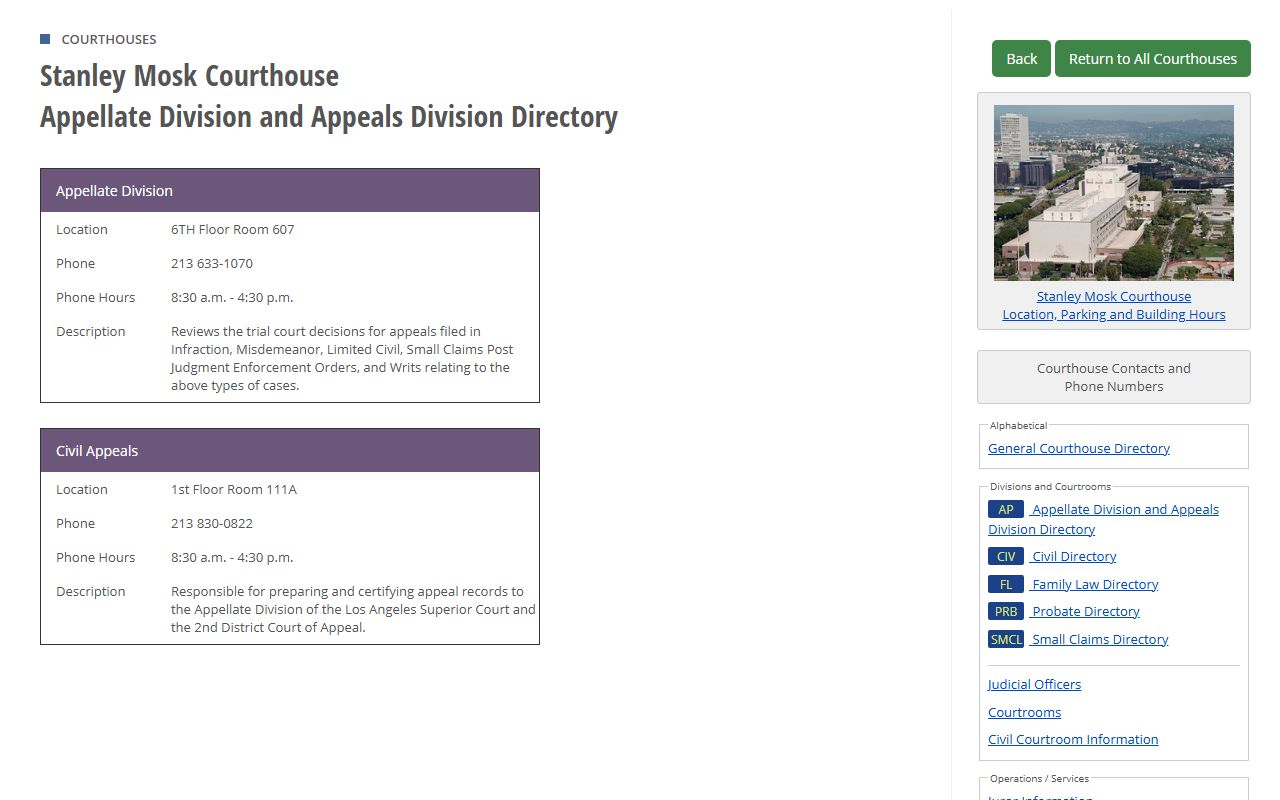
The Appellate Division directory lists rooms, phones, and divisions inside Stanley Mosk.
Stanley Mosk Courthouse Contact
The official Stanley Mosk Courthouse location page lists the central court address, hours, parking note, and district. The screenshot below comes from that page.
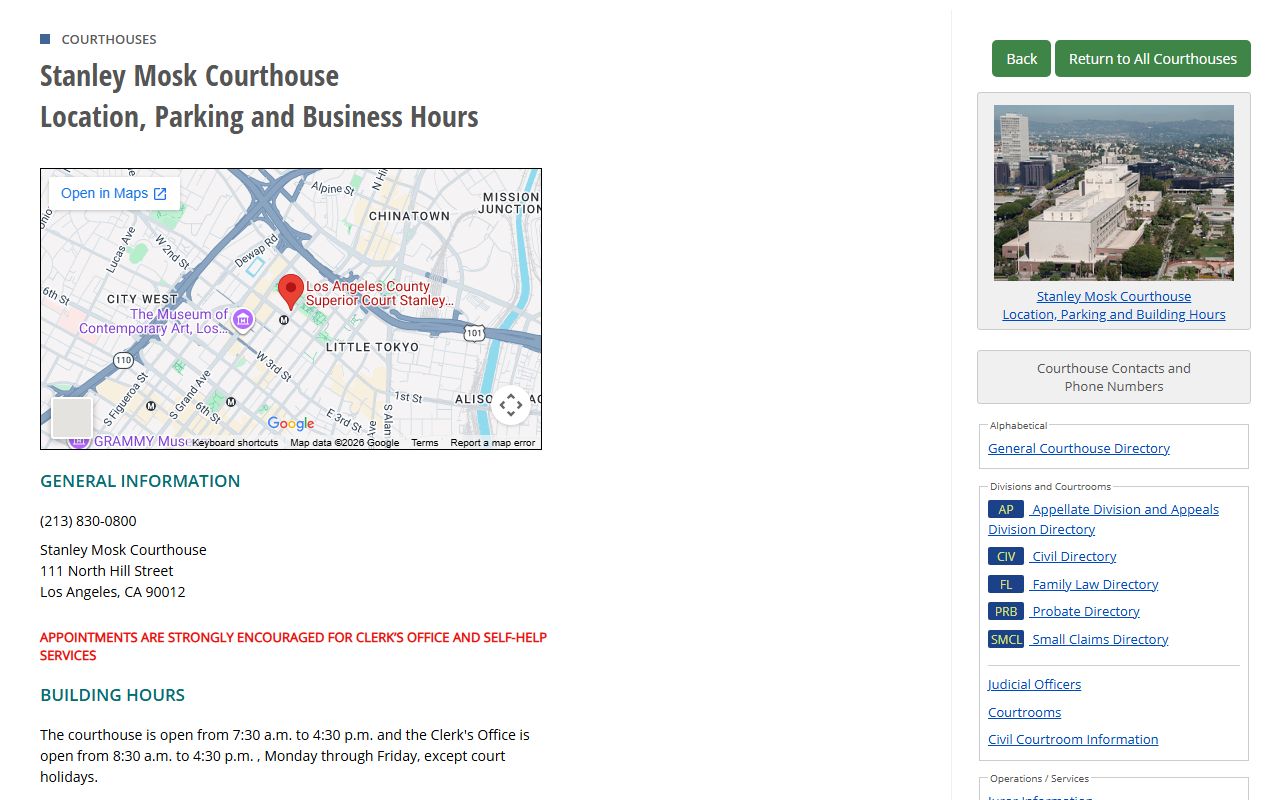
It is the first stop for confirming hours and security notices before a visit.
Stanley Mosk Courthouse
111 North Hill Street
Los Angeles, CA 90012
(213) 830-0800
Central Judicial District
Civil Records and Copies
111 North Hill Street, Room 112
Los Angeles, CA 90012
(213) 830-0803
Mon-Fri, 8:30 a.m. to 4:30 p.m.
Appellate Division
111 North Hill Street, Room 607
Los Angeles, CA 90012
(213) 633-1070
6th Floor
Small Claims sits in Room 113 with the same civil phone line. Civil Appeals sits in Room 111A at (213) 830-0822. The court's civil directory shows civil filing in Room 102. The Sheriff's Office at Stanley Mosk sits in Room 525 at (213) 972-3930.
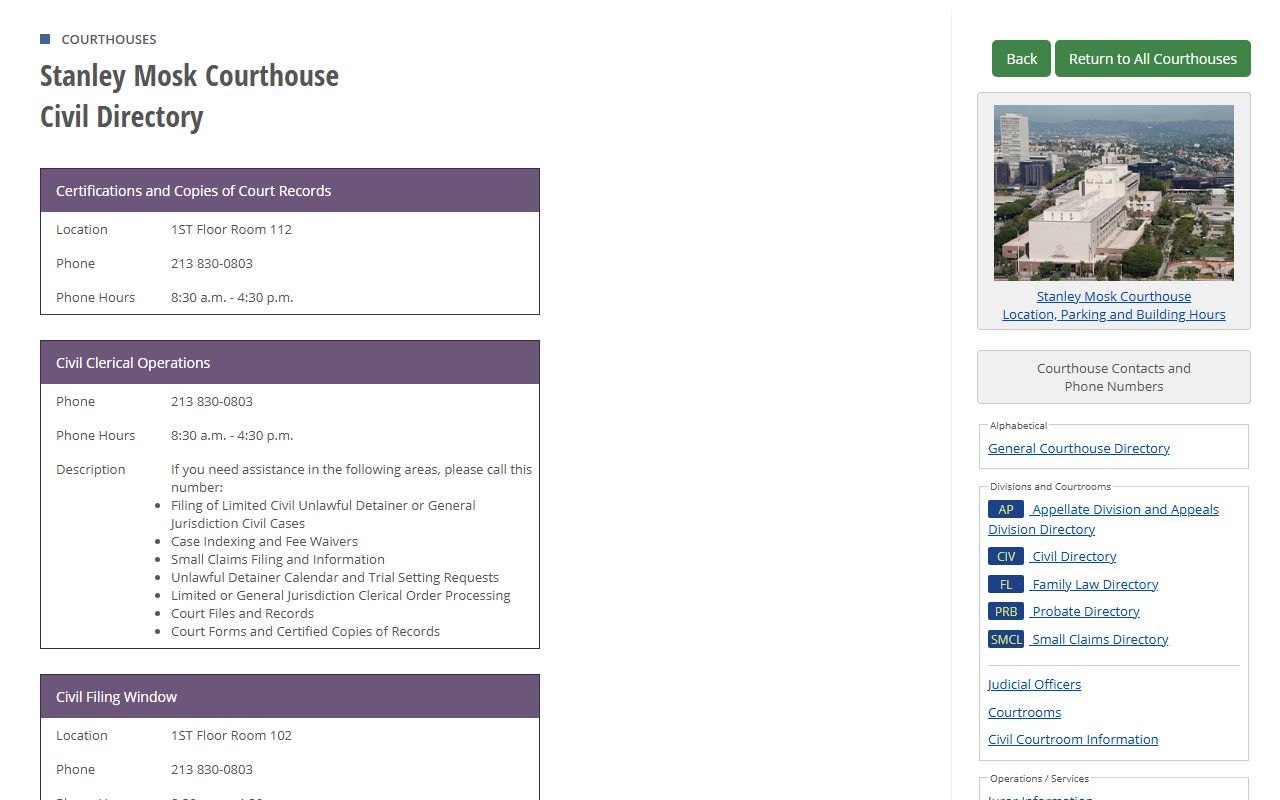
Use that directory for room numbers and phone hours before going to the courthouse.
Jurors report to Room 253 under the one-trial term, per the official juror information page, and may be sent to Clara Shortridge-Foltz, East Los Angeles, Metropolitan, Spring Street, or Hollywood Courthouse.
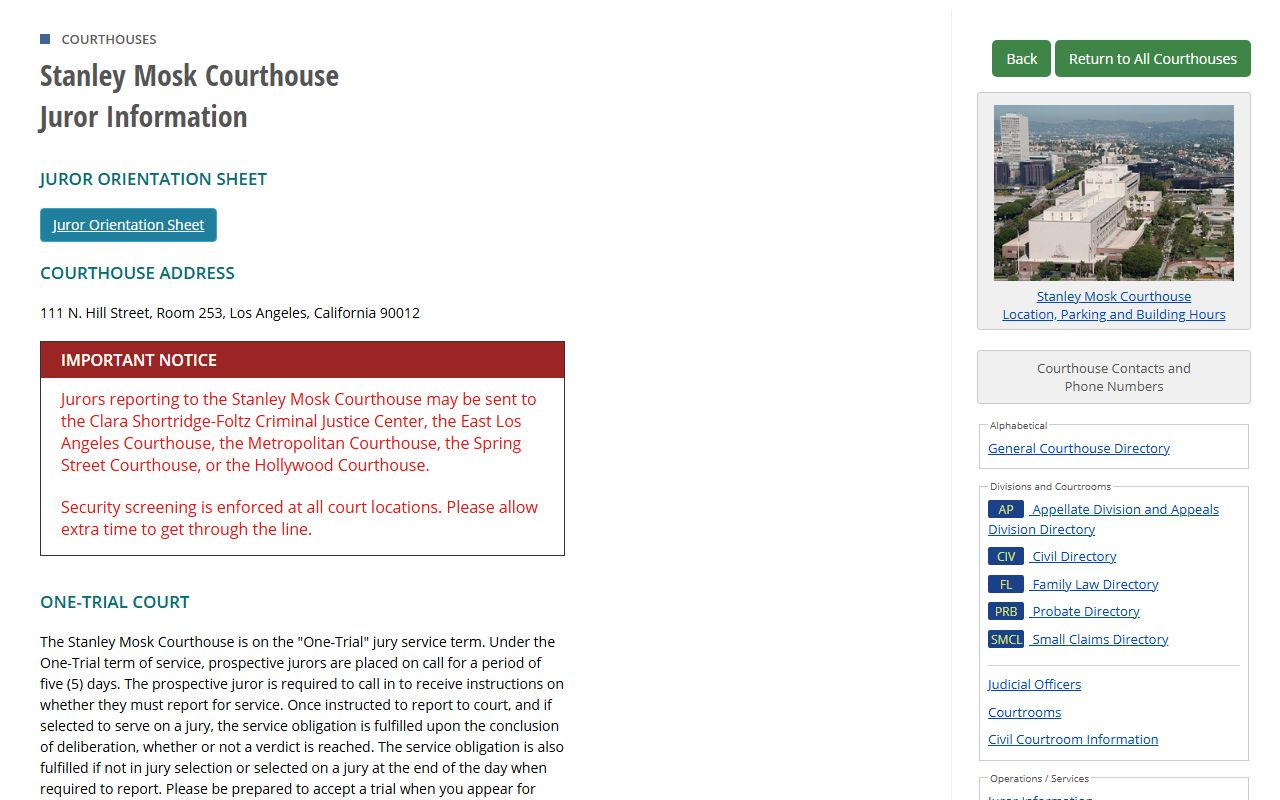
The juror page also explains the security screening process at every Los Angeles court location.
Small claims hours and contact run through the dedicated small claims directory.
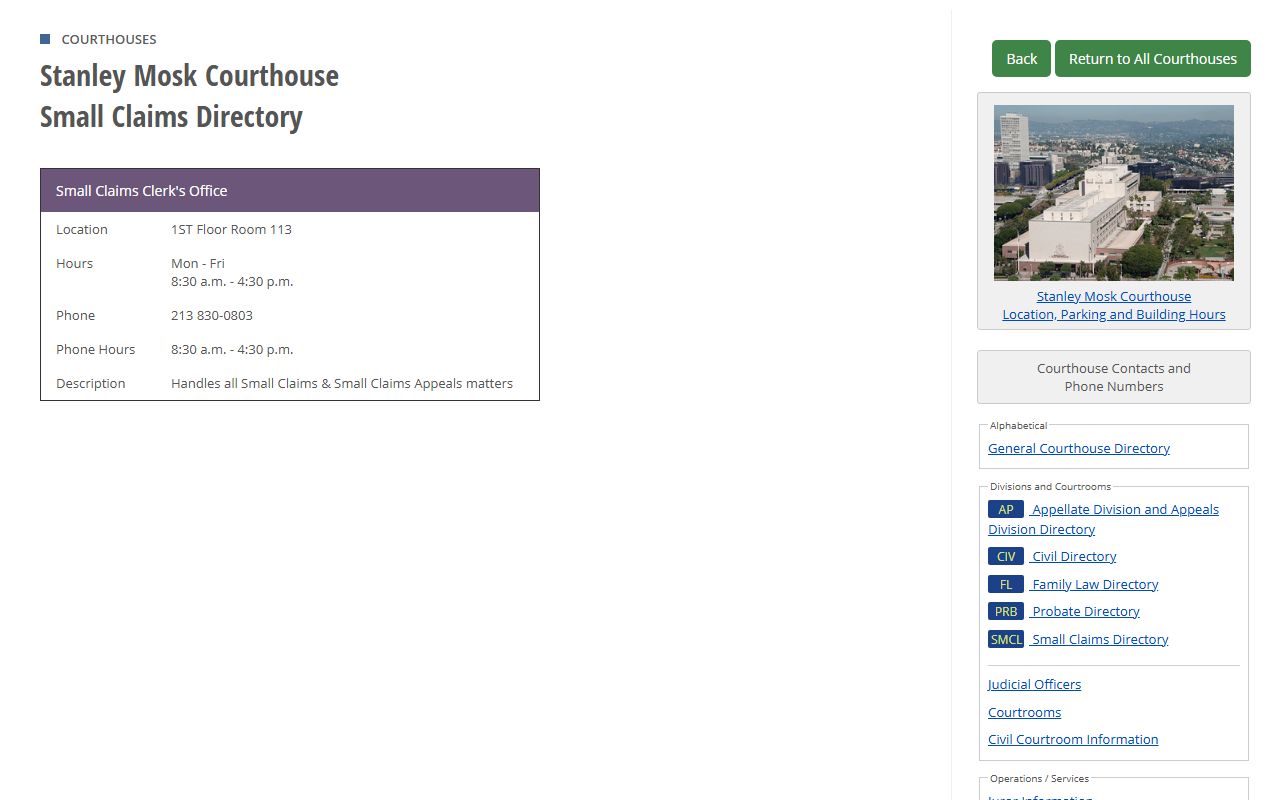
The same line, (213) 830-0803, handles civil clerical and small claims questions.
Frequently Asked Questions
Where do I search Los Angeles County court records?
Use the Superior Court of California, County of Los Angeles PAOS system. It covers civil, family law, probate, small claims, and criminal name search. Document images sit in the same portal. The RR/CC does not hold divorce decrees or court dockets. If the case predates online coverage, contact Archives or the courthouse holding the file.
Is LA Superior Court case search free?
Not for PAOS name search or document images. The court charges public access fees under California Rule of Court 2.506 and Government Code section 68150. Guest name searches are $4.75 each. Registered user fees vary by monthly volume. Document images run $1 a page for the first five pages, $0.40 a page after that, with a $40 cap per document.
How far back do criminal name searches go?
Felony searches go back to 1980. Misdemeanor searches go back to 1988, though some misdemeanor records may reach 1983 depending on when the old Municipal Court branches automated their files. Traffic and other infractions are not included. The Traffic Division handles those.
Where do I get a divorce decree?
From the Superior Court, not the Registrar-Recorder/County Clerk. RR/CC's marriage record pages send users to the court for divorce decrees and family law case files. Use PAOS family law name search for cases from 1983 to present, with document images from May 1, 2000.
How do I find someone in Los Angeles County jail?
Use the LASD Inmate Information Center at app5.lasd.org/iic/. Search by last name, first name, middle name, and date of birth. Solve the reCAPTCHA. Bookings in the last two hours will not show. For help, call (213) 473-6100. The Inmate Answering Service is (213) 473-6002.
Who is the current Sheriff?
Robert G. Luna is the 34th Sheriff of Los Angeles County. He leads LASD, which the department says is the largest sheriff's department in the country with nearly 18,000 budgeted sworn and professional staff.
Who is the current District Attorney?
Nathan J. Hochman is the current Los Angeles County District Attorney. The official DA release shows he was sworn in on December 3, 2024.
Is there an official warrant search?
No countywide active-warrant public search portal was located in this research. Use the court case file, contact the criminal clerk, or contact law enforcement or counsel. Do not rely on commercial warrant sites. More on the warrant records page.
More questions and answers sit on the Los Angeles County Court Records FAQ page.