
Los Angeles County Warrant Search Overview
Warrants in Los Angeles County are issued by judicial officers of the Superior Court of California, County of Los Angeles or by federal judges sitting in the Central District of California. State-court warrants live in the case files of the criminal division and may also touch family, civil, and probate matters when a body attachment is involved. The public side of those records is reached through the court's case access systems. The arrest side, when a warrant has resulted in a person being booked, is reached through the Los Angeles County Sheriff's Department.
The court's online case access runs through Public Access Online Services for criminal cases, with paid name searches and a separate document image system. The sheriff's public custody data is at the LASD Inmate Information Center. The Inmate Information Center notes that bookings within the last two hours will not yet appear and that a reCAPTCHA step blocks bulk scraping. Both systems update each day.
Why There Is No Public LA County Warrant Portal
The research into official Los Angeles County sources found no public active-warrant search portal at LASD or at the Superior Court. This is an important finding for any reader running a Los Angeles County warrant search. Many third-party sites claim to run "free warrant searches" for the county. None of those sites are the official record, and none should be used as a basis for a legal decision. The official record is the case docket or a direct call to the courthouse.
The reason for the gap is practical and legal. Some warrants are sealed by court order at the time of issuance to protect an active investigation. Some warrants are tied to juvenile cases and fall under Welfare and Institutions Code section 827. Some warrants involve victim safety and have address blocks. A blanket public list would conflict with all three policies at once.
Note: A site that advertises a county-wide active-warrant lookup for Los Angeles is not pulling from an official county source and should not be relied on to decide whether to turn yourself in.
Types of Warrants in Los Angeles County
Warrants are not all the same. Each kind has its own legal basis, its own trigger event, and its own follow-up process. A clear sense of which type is in play makes the next step easier to plan.
- Arrest warrant — issued when a judge finds probable cause that a person committed a crime. It directs law enforcement to take the person into custody.
- Bench warrant — issued by a judge from the bench, usually after a failure to appear, a missed probation date, or contempt of court.
- Search warrant — authorizes law enforcement to search a place, a person, or a device. These are often sealed before execution and during an investigation.
- Fugitive warrant — used when another jurisdiction seeks custody of a person located in Los Angeles County.
- Body attachment or civil warrant — arises in family law, child support enforcement, judgment debtor exams, and contempt actions where a person ignored a court order.
Each type can carry a bail amount, a hold, or a recall condition. Each can also be tied to a court date that controls how the matter is cleared.
How Warrants Appear in Los Angeles Superior Court Records
The most reliable public path to a Los Angeles County warrant search is the criminal case record. PAOS criminal name search returns the case number, defendant name, filing date, and filing location. Once a case number is in hand, the docket and minute orders show warrant-related events. These include the issuance entry, any bail amount set, the failure-to-appear flag, holds placed on the matter, and any later recall or quash order.
Coverage on PAOS criminal goes back to 1980 for felony cases and 1988 for misdemeanors. Some former municipal-court misdemeanor data may reach 1983. Traffic and other infractions are excluded from the criminal name search and route to the Traffic Division. The static field set on the PAOS criminal page is the same one that drives any warrant-related docket search.
| Field Label | Type | Required | Notes |
|---|---|---|---|
| Defendant name | Text | Yes | Static page does not expose the first, last, and middle split. |
| Guest or registered user | Transaction choice | Yes | Each criminal name search carries a fee. |
| Case Type | Result field | n/a | Felony or misdemeanor coverage range. |
| Case Number | Result field | n/a | Used to pull docket events including warrant entries. |
| Filing Date | Result field | n/a | Anchors the start of the docket timeline. |
| Filing Location | Result field | n/a | Maps to the criminal courthouse holding the file. |
Because no separate warrant portal exists, this is the search-field table to use. The court relies on the same name search to surface the underlying case where warrant orders are entered.
A sample list of the warrant-related fields that may appear in a criminal docket gives a clearer picture of what a result file shows.
- Docket event line — the date and short text of any warrant issuance or recall.
- Bail or bond amount — the dollar amount set by the judge at issuance.
- Failure to appear flag — an FTA entry tied to the missed hearing.
- Hold information — any agency hold attached to a custody record.
- Next court date — the rescheduled hearing where the matter can be put back on calendar.
- Recall or quash order — the later entry that removes the warrant from active status.
- Issuing department — the courtroom number that issued the order.
The same fields drive what counsel needs to know before walking a client back into court.
LASD Inmate Profiles and Warrant-Related Holds
The Los Angeles County Sheriff's Department, led by Sheriff Robert G. Luna, runs the public custody data system at the LASD Inmate Information Center. The portal lists publicly releasable inmate information under Custody Division Manual section 3-04/040.00. The list includes booking details, arrest information, bail amount, housing location, court dates and location, release date, holds, and visiting days and hours. The hold field is where warrant-related entries from other agencies tend to appear when a person is already in custody.
Custody Division contact runs through the general line at (213) 473-6100 and the Inmate Answering Service at (213) 473-6002. The Information Center also notes the two-hour lag on new bookings and the reCAPTCHA requirement that blocks automated scraping. A booking that ties to a fresh arrest warrant may not show on the public side for a short window after intake.
For a deeper view of custody data, see the inmate records page. For people already out of custody, the released inmates page covers VINELink alerts, CDCR, and BOP locators.
How to Resolve a Bench Warrant in Los Angeles County
A bench warrant is the most common warrant a private person encounters in Los Angeles County. It usually follows a missed hearing in a traffic, misdemeanor, or family matter. The steps below outline the official path the court and the sheriff describe. Commercial warrant websites are not part of any of these steps.
- Identify the case. Run a PAOS criminal name search, a PAOS civil name search if the matter is civil, or a Traffic Division ticket lookup if a citation triggered the warrant.
- Pull the case number and the filing location. Both appear in the PAOS name result.
- Contact the criminal clerk at the listed courthouse, or call counsel. The clerk or a lawyer can confirm the warrant status and ask the court to place the matter back on calendar.
- Appear at the rescheduled hearing. The judge may recall or quash the warrant on appearance and set bail or release conditions.
- If a person is taken into custody on the warrant, use the LASD Inmate Information Center to confirm the booking and the next court date.
- If bail is set, follow the court and LASD bail-posting rules. Verify accepted payment methods and hours.
- After any recall or quash order, allow administrative time for downstream databases to reflect the change.
The steps above match the LA Court self-help guidance and the LASD manuals cited above. The LA Court Self-Help Service Catalog can also direct a self-represented person to the right form.

Stanley Mosk Courthouse at 111 North Hill Street is the central civil and probate hub, while the Clara Shortridge-Foltz Criminal Justice Center handles the bulk of downtown criminal calendars.
Bail and Court Appearance
California's Penal Code controls bail and the conditions for release. A judge sets bail at warrant issuance or at first appearance. Bail can be paid in cash or posted through a licensed bail bond agent. A person who appears voluntarily often has a better chance at a recall than a person picked up on the street. Counsel can argue for own-recognizance release at the rescheduled hearing in many lower-level matters.
The LASD station jail orientation form, listed in custody manual section 6-14/020.00, covers bail reduction and own-recognizance releases as part of the standard intake material. The form also covers visiting information, rules and discipline, hygiene access, reading material, telephone calls, medical and mental health procedures, and PREA standards. None of that material is a substitute for counsel, but it gives a baseline of what a defendant can expect after a warrant arrest.
Important: Consult a California criminal defense lawyer before any voluntary surrender on a Los Angeles County warrant; the timing and the courtroom matter to the recall outcome.
Failure to Appear Penalties
Failure to appear in a traffic matter triggers an FTA action under California Vehicle Code section 40508. The state can impose a civil assessment in addition to the original fine. The Los Angeles Superior Court traffic division handles traffic and infraction FTAs separately from criminal misdemeanor FTAs. Traffic citations route through the Traffic Division portal, not the PAOS criminal page. For a deeper view of the traffic path, the bail schedule, and any related driver-record impact, see traffic court records.
For criminal cases, a missed appearance can result in a new bench warrant and a new charge for the failure itself. The judge can also revoke bail or modify the conditions of release. The original case keeps moving in the background, and any pretrial credit or speedy-trial calculation can be affected by the missed date.
Searching for Outstanding Warrants Through Counsel
The most practical Los Angeles County warrant search runs through counsel. A defense attorney with a State Bar number can call the criminal clerk, request a docket review, and confirm whether an active warrant exists without exposing the client to immediate arrest. The Los Angeles County Public Defender represents qualifying indigent defendants once a case has been filed. The State Bar of California lawyer referral system can connect a person to private counsel for the pre-filing warrant question.
The Public Defender's services list, posted at pubdef.lacounty.gov, includes Criminal Defense, Treatment Courts, Juvenile Advocacy, Immigration, Racial Justice, Mental Health, in-house social workers, and Partners for Justice client advocates. The Alternate Public Defender picks up cases where the Public Defender has a conflict. Both offices have walked many clients through the bench-warrant recall process at the criminal courthouses listed on the Superior Court page.
For an underlying charge or a conviction record tied to the warrant, see criminal records. For full case files including civil and family matters, see court records.
Sealed Warrants and Juvenile Warrants
Some warrants are kept off the public side of any system. Sealed warrants under California Rule of Court 2.550 require the court to make findings before sealing. A common example is a search warrant sealed during an active investigation. The seal can be challenged later, but the public docket entry stays restricted while the seal is in effect.
Juvenile warrants are protected under Welfare and Institutions Code section 827. The statute limits inspection of juvenile case files to authorized persons such as parties, attorneys, child welfare workers, and probation officers. A member of the public usually needs juvenile court permission to view the file. The same restriction applies to any warrant entry that sits inside a juvenile case.
Note: An arrest record that resulted in no conviction may also be sealed under Penal Code section 851.91 through Form CR-409 once the case is closed.
Federal Warrants — High Level
Federal warrants in Los Angeles County come from judges of the U.S. District Court for the Central District of California. The U.S. Attorney's Office for the Central District handles federal prosecutions. Federal arrest warrants are not searchable through a public county portal. Many federal warrants are sealed until execution. After a person is arrested on a federal warrant, federal custody data moves to the Bureau of Prisons inmate locator once the person is processed.
The federal courthouse footprint in downtown Los Angeles includes the First Street U.S. Courthouse at 350 West 1st Street, the Edward R. Roybal Federal Building at 255 East Temple Street, and the Spring Street federal courthouse at 312 North Spring Street. Federal criminal cases are searched on PACER, which charges per page subject to a small-volume waiver. A reader running a Los Angeles County warrant search that may involve a federal supervised release matter should run a PACER name check alongside any PAOS lookup.
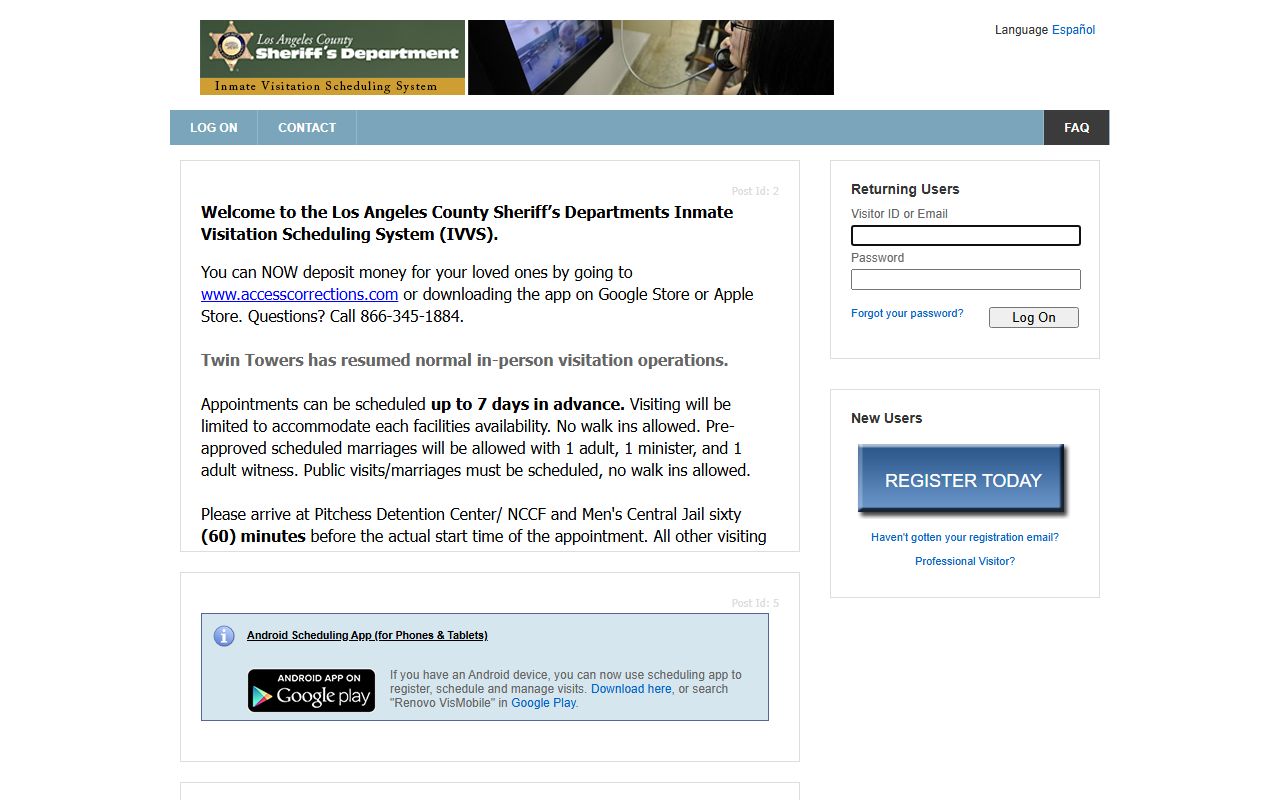
The LASD Inmate Video Visitation System is the scheduling tool family members use once a person has been taken into custody on any warrant.
Six Los Angeles County Superior Court judges were appointed by Governor Newsom in June 2025, per the official appointments release, and those judges now sit on calendars that hear bench-warrant recall requests.